The right camera lens adapter can help you use existing lenses on a new camera body, expand your creative options, and avoid replacing an entire kit.
This roundup covers electronic autofocus converters, manual mount adapters, and filter-ring solutions across popular Canon, Nikon, Leica, and Micro Four Thirds systems.
Best 10 Camera Lens Adapters Picks for 2026
Best OEM Choice

- Supports Canon EF and EF-S lenses
- Metal, dust- and water-resistant design
- Made for compatible EOS R-series cameras
Best For: Canon users seeking a dependable OEM adapter
Best for Adaptall II Lenses

- Fits Tamron Adaptall II lenses
- All-metal construction
- Infinity focus guaranteed
Best For: Micro Four Thirds photographers using Adaptall II glass
Best Filter Compatibility Kit
K&F CONCEPT 18-Piece Filter Ring Set

- Includes 18 step-up and step-down rings
- Covers 37mm to 82mm thread sizes
- Aluminum alloy construction
Best For: Sharing filters across lenses with different thread sizes
Best Feature-Packed Alternative

- Supports autofocus and aperture control
- Transmits key lens and camera data
- Fits multiple Canon EOS R-series bodies
Best For: Canon users wanting electronic EF/EF-S lens communication
Filter Flexibility

- Nine rings cover 37mm to 82mm
- Fits larger filters onto smaller lenses
- Durable anodized aluminum construction
Best For: Sharing filters across lenses with different thread sizes
Electronic Control

- Mounts EF and EF-S lenses on EOS-M bodies
- Supports AF, aperture, IS, and EXIF data
- Includes a detachable 1/4-inch tripod base
Best For: Canon EOS-M users adapting EF or EF-S lenses
Manual Mount Conversion

- Connects Nikkor F lenses to Leica M bodies
- Precision brass-and-aluminum construction
- Manual exposure and focus operation
Best For: Leica M photographers adapting Nikon F-mount lenses
Top Feature-Packed Pick
SNIPIZ EF-EOS R Auto-Focus Adapter

- Supports Canon EF/EF-S lenses on EOS R cameras
- Retains autofocus, stabilization, and EXIF transmission
- Metal body with removable tripod mount
Best For: Canon EOS R users adapting electronic EF or EF-S lenses
Best for Aperture Control
Fotodiox Nikon F G-Type to Canon EF Adapter
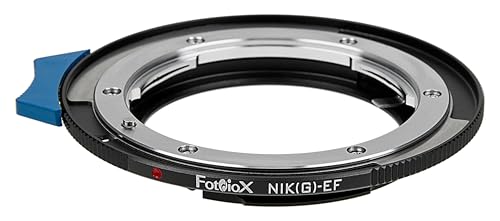
- Mounts Nikon F G-type lenses on Canon EF/EF-S bodies
- Built-in dial controls aperture
- All-metal design with infinity focus
Best For: Manual Canon DSLR shooting with Nikon G-type lenses
Best Simple Manual Adapter
Fotodiox Pro Nikon F to Canon EOS Adapter

- Fits Nikon Nikkor F lenses on Canon EF/EF-S SLRs
- Manual design with infinity focus
- Hardened anodized aluminum construction
Best For: Canon EOS DSLR users seeking a durable manual adapter
Best OEM Choice – Canon EF-EOS R Mount Adapter
Canon Mount Adapter EF-EOS R | Allows EF/EF-S Lens Compatibility with EOS R Cameras
Check Price On AmazonFor photographers building a Canon RF system around existing DSLR glass, this camera lens adapter provides a straightforward way to use Canon EF and EF-S lenses on compatible EOS R-series cameras. Its metal mounts and dust- and water-resistant construction make it a practical everyday option.
Best For: Canon EOS R, RP, R5, or R6 users who want an OEM adapter for EF or EF-S lenses.
Pros:
- Supports Canon EF and EF-S lens compatibility.
- Compatible with several EOS R-series cameras, including the EOS R, RP, R5, and R6.
- Metal mounts on both the lens and camera sides.
- Dust- and water-resistant exterior design.
Cons:
- Designed for Canon RF-mount cameras rather than a broad range of systems.
- Does not add a control ring or drop-in filter functionality.
This is the sensible pick when you prioritize Canon branding, matching exterior design, and a rugged basic connection over extra features.
Best for Adaptall II Lenses – Fotodiox Tamron-MFT Adapter
This Fotodiox adapter is a focused solution for photographers who want to mount Tamron Adaptall II lenses on Micro Four Thirds cameras. The all-metal design, smooth mounting surface, and guaranteed infinity focus make it a practical manual-adaptation option.
Best For: Micro Four Thirds users with Tamron Adaptall II lenses who are comfortable with manual exposure and focusing.
Pros:
- Specifically fits Tamron Adaptall II lenses to Micro Four Thirds cameras.
- All-metal construction.
- Designed for smooth mounting and accurate flange-to-focus distances.
- Infinity focus is guaranteed, with a 24-month warranty.
Cons:
- No image stabilization.
- Manual exposure control is specified.
- Not water resistant.
Choose this adapter when compatibility with Tamron Adaptall II lenses is the priority; it is less suitable if you need stabilization or fully automated shooting features.
Best Filter Compatibility Kit – K&F CONCEPT 18-Piece Filter Ring Set
Unlike a lens-mount adapter, this K&F CONCEPT kit adapts filter-thread sizes so lenses can share accessories such as filters, hoods, flashes, and lens converters. The 18-piece set includes both step-up and step-down rings for a broad range of common thread sizes.
Best For: Photographers who use multiple lenses and need to match different filter-thread diameters with existing accessories.
Pros:
- Includes nine step-up and nine step-down rings.
- Covers thread combinations from 37mm through 82mm.
- Designed for tight fitting without wobbling or cross-threading.
- Aluminum alloy construction offers impact and pressure resistance.
Cons:
- Adapts filter threads, not camera lens mounts.
- Not water resistant.
- Requires selecting the correct ring combination for each lens and accessory.
This is a versatile accessory kit for expanding filter compatibility across a mixed lens collection, but it should not be confused with an adapter for mounting a lens on a different camera system.
Best Feature-Packed Alternative – YELLBIN EF-EOS R Adapter
Lens Mount Adapter EF-EOS R for Canon EF/EF-S Lens to Canon EOS R RP R5 R6 R7 R10 Cameras
Check Price On AmazonFor Canon mirrorless owners seeking camera lens adapters with electronic functionality, this YELLBIN EF-EOS R model is designed to connect EF/EF-S lenses to a range of EOS R-series cameras. It is specified with autofocus, aperture control, EXIF transmission, and built-in stabilization support.
Best For: Canon EOS R-series users who want electronic communication between compatible EF or EF-S lenses and the camera body.
Pros:
- Compatible with Canon EOS R, RP, R5, R6, R7, and R10 cameras.
- Supports autofocus and camera-side aperture control.
- Transmits shutter, aperture, and ISO data to the camera.
- Features metal mounts and dust- and water-resistant construction.
Cons:
- Third-party adapter rather than a Canon-branded accessory.
- Compatibility is specified for the listed EOS R-series models and EF/EF-S lenses.
- Built-in stabilization is described as digital, so results may vary by camera and lens combination.
This option is attractive when electronic lens communication matters, offering more listed functionality than a basic mechanical adapter while retaining a rugged metal-mounted design.
Filter Flexibility – 9-Piece Step-Up Ring Set
For photographers comparing camera lens adapters, this CamKix set is designed to reuse larger filters on lenses with smaller front diameters. Its nine anodized-aluminum rings cover a continuous range from 37mm to 82mm, making it a practical option when your lenses use different filter sizes.
Best For: Photographers who want to share larger lens filters across multiple interchangeable-lens cameras and lenses.
Pros:
- Includes nine step-up sizes from 37-49mm through 77-82mm.
- Allows larger filters to fit lenses with smaller diameters.
- Uses durable anodized aluminum rather than plastic rings.
Cons:
- These are filter adapter rings, not lens-mount converters.
- The set only steps up to the listed size combinations, so compatibility depends on your lens and filter threads.
This is a useful value-oriented kit if your main goal is filter-size compatibility. Confirm both your lens thread sizes and filter diameters before buying.
Electronic Control – EF-EOS M Autofocus Adapter
Among camera lens adapters, this EF-EOS M converter is aimed at Canon EOS-M users who want to mount Canon EF and EF-S lenses while retaining electronic functions. The adapter supports autofocus, aperture control, image stabilization, and EXIF signal transmission for compatible setups.
Best For: Canon EOS-M owners using EF or EF-S lenses who want electronic lens communication and a detachable tripod-support option.
Pros:
- Compatible with Canon EF and EF-S lenses and listed EOS-M cameras.
- Supports autofocus, aperture control, image stabilization, and EXIF transmission.
- Includes a detachable base with a 1/4-inch tripod socket.
- Uses gold-plated signal pins and metal electronic contacts.
Cons:
- Compatibility is limited to the specified Canon EF/EF-S and EOS-M mount combination.
- It is not water resistant.
- Full-frame use may require turning off the camera’s APS-C Size Capture setting, according to the supplied notes.
This adapter is the stronger choice for maintaining camera-side controls with older or existing EF and EF-S glass on an EOS-M body. Verify your exact camera model and lens combination before purchase.
Manual Mount Conversion – Nikon F to Leica M Adapter
K&F Concept Lens Mount Adapter for Nikon Nikkor F Mount Lens to Leica M Mount Camera Body
Check Price On AmazonThis K&F Concept adapter provides a mechanical connection between Nikon Nikkor F-mount lenses and Leica M-mount camera bodies. For photographers considering camera lens adapters for a manual setup, its brass-and-aluminum construction offers a compact fit, but exposure control is manual and focus behavior at infinity requires attention.
Best For: Leica M users who want to mount Nikon Nikkor F lenses and are comfortable focusing and controlling exposure manually.
Pros:
- Designed for Nikon Nikkor F lenses and Leica M-series camera bodies.
- Precision-made brass and aluminum construction.
- Compact design with stated shock-absorption and water-resistant protection.
Cons:
- Exposure control is manual.
- The supplied notes do not indicate electronic autofocus or EXIF transmission.
- Infinity focus may be shifted slightly beyond the infinity mark, so focus should be checked through the viewfinder.
This adapter suits photographers prioritizing cross-system lens use over automation. Its manual operation and infinity-focus caveat make careful setup and viewfinder checking especially important.
Top Feature-Packed Pick – SNIPIZ EF-EOS R Auto-Focus Adapter
For Canon mirrorless owners comparing camera lens adapters, this SNIPIZ model connects Canon EF and EF-S lenses to EOS R-series cameras while preserving several electronic features. It supports autofocus, compatible lens stabilization, and EXIF data transmission.
Best For: Canon EOS R-series users who want to continue using EF or EF-S lenses with electronic communication.
Pros:
- Compatible with a broad range of Canon EOS R-series cameras, including the R, RP, R5, R6 II, R7, R10, R50, and R100.
- Supports autofocus, image stabilization, and EXIF data transmission with compatible lenses.
- Metal construction, brass mounting plates, and a removable built-in tripod mount add stability.
Cons:
- Electronic functions depend on compatibility between the attached lens and camera.
- It is designed for Canon EF/EF-S lenses and Canon R-mount cameras rather than a broad range of systems.
This is the most feature-oriented option in the group. Its electronic support and tripod-mount design make it a practical choice when adapting Canon DSLR lenses for regular shooting or video work.
Best for Aperture Control – Fotodiox Nikon F G-Type to Canon EF Adapter
This Fotodiox adapter is a useful choice among camera lens adapters for mounting Nikon F-mount G-type lenses on Canon EF and EF-S cameras. Its built-in aperture dial gives manual control over G-type lenses that lack an aperture ring.
Best For: Canon EF or EF-S camera users who want to explore Nikon F-mount lenses, including vintage optics, with manual exposure control.
Pros:
- Fits Nikon F-mount G-type lenses on Canon EF and EF-S mount cameras.
- Built-in aperture control dial accommodates G-type lenses.
- All-metal construction provides a secure fit, and infinity focus is allowed.
Cons:
- Manual-focus operation requires hands-on focusing.
- Exposure control is manual, with no stated electronic autofocus or EXIF communication.
- The adapter is intended for Canon EF/EF-S cameras, not Canon RF-mount bodies.
Choose this model when adapting Nikon glass to a Canon DSLR is the priority. The aperture dial is its key advantage, particularly for G-type lenses, but expect a fully manual shooting experience.
Best Simple Manual Adapter – Fotodiox Pro Nikon F to Canon EOS Adapter
For photographers seeking straightforward camera lens adapters, this Fotodiox Pro model mounts Nikon Nikkor F lenses on Canon EOS cameras with EF or EF-S mounts. It uses a manual design and emphasizes precision fit and infinity focus.
Best For: Canon EOS DSLR users who want a durable, uncomplicated way to use Nikon F-mount lenses manually.
Pros:
- Compatible with Nikon Nikkor F-mount lenses and Canon EOS EF/EF-S mount SLR cameras.
- Precision craftsmanship supports infinity focus or beyond.
- Hardened anodized aluminum construction offers a durable all-metal design.
Cons:
- This is a manual adapter, so autofocus and electronic lens communication are not provided.
- The supplied details do not indicate an aperture-control mechanism for G-type lenses.
This option keeps the setup simple and solid. It is a good fit for users who value a precise mechanical connection and infinity focus over automated camera-lens functions.
How We Picked These Camera Lens Adapters
We selected adapters based on mount compatibility, intended use, construction, control support, and practical value. The list includes electronic adapters designed to preserve autofocus or camera communication, as well as simpler mechanical models for mounting legacy lenses. Filter rings are included separately because they solve a related sizing problem rather than changing the lens mount itself.
Before ordering, verify both sides of the connection: the lens mount, the camera mount, and whether the adapter supports the features you need. A correct-looking product title is not enough, especially when different Canon EF, EF-S, EF-M, and RF systems are involved.
Quick Comparison
- Best for Canon RF users: Canon EF-EOS R and compatible EF-to-RF autofocus adapters.
- Best for Canon EOS M users: EF-EOS M adapters for EF and EF-S lenses.
- Best for Nikon F lenses: Nikon F-to-Canon EF or Nikon F-to-Leica M adapters, depending on the camera body.
- Best for Micro Four Thirds: Adaptall II-to-MFT adapters.
- Best for filters: Step-up and multi-piece filter-ring sets.
Key Buying Factors for Camera Lens Adapters
Mount Compatibility
Check the exact lens and camera mounts, not just the brand name. Canon RF, EF, EF-S, and EF-M are different standards, while Nikon F lenses may require aperture-control support depending on the lens design.
Electronic Versus Mechanical Operation
Electronic adapters may retain autofocus, aperture control, image stabilization communication, and EXIF data, but performance varies by camera and lens. Mechanical adapters are usually simpler and more affordable, though they commonly require manual focusing and aperture adjustment.
Crop Factor and Clearance
An adapter does not normally change a sensor’s crop factor, but it can affect handling and balance. Confirm that the lens does not protrude too far into the camera body and that the combination supports the intended focus range, including infinity focus where needed.
Build Quality and Alignment
Look for a secure locking mechanism, minimal play, accurate flange distance, and durable metal construction. Poor alignment can cause soft images, difficult mounting, or inconsistent focusing.
Filter Sizing
For filter adapters, identify the lens’s filter-thread diameter first. Step-up rings let you use one larger filter across multiple lenses; they do not let a smaller filter cover a larger thread and should not be confused with lens-mount adapters.
Who Should Buy Which Camera Lens Adapters?
Choose a Canon-branded or well-reviewed electronic EF-to-RF adapter if dependable autofocus and camera communication matter for portraits, events, or moving subjects. A manual Nikon F adapter is a better fit for deliberate, controlled shooting with older lenses, while an aperture-enabled model is more useful for Nikon G lenses without an external aperture ring. Photographers adapting specialist or vintage glass to Micro Four Thirds or Leica M bodies should prioritize precise fit and manual-control expectations. Finally, choose a filter-ring set when your goal is to share filters—not to mount a lens on a different camera system.