Extension tubes offer an affordable way to turn compatible DSLR lenses into close-focusing macro tools. By moving the lens farther from the sensor, they increase magnification without adding extra glass.
This roundup compares 10 options for Canon and Nikon DSLR systems, plus selected Sony-compatible models. The right choice depends on your mount, desired magnification, and whether you need autofocus and electronic metering to remain available.
Best 10 Camera Extension Tubes for Dslr Cameras Picks for 2026
Versatile Canon Set

- Includes 12mm, 20mm, and 36mm tubes
- No optics for close-focus extension
- Designed to retain AF and TTL auto exposure
Best For: Canon EOS users wanting three extension lengths
Compact Sony Option

- Two tubes create three extension combinations
- Supports autofocus configuration
- Lightweight and portable design
Best For: Sony NEX and Alpha users shooting close-ups outdoors
Simple Canon Macro Upgrade

- Adds 25mm of extension
- Supports autofocus and metering passthrough
- Compatible with Canon EF and EF-S
Best For: Canon EOS users wanting one dedicated macro tube
Flexible Sony E-Mount Set

- 10mm and 16mm tubes can be used separately or stacked
- Supports AF and all shooting modes
- Fits Sony E-mount APS-C and full-frame cameras
Best For: Sony E-mount users needing adjustable close-up extension
Best Metal Build
Fotodiox Canon EF/EF-S Extension Tube Set

- All-metal construction
- Multiple macro combinations
- Designed for Canon EF/EF-S cameras
Best For: Canon users prioritizing durability and manual macro control
Best Nikon Versatility
Meike N-AF1-A Auto Focus Tube Set

- 12mm, 20mm, and 36mm tubes
- Seven possible combinations
- Electronic autofocus support
Best For: Nikon DSLR users seeking flexible macro magnification
Best Nikon Compatibility
Mcoplus Extnp Auto Focus Tube Set

- Works with Nikon AF/AF-S DX/FX cameras
- Three interchangeable tube lengths
- Autofocus and manual focus support
Best For: Nikon DSLR owners wanting broad compatibility and adjustable magnification
Flexible Canon Macro Control
VILTROX DG-C Extension Tube Set

- Three lengths: 12mm, 20mm, and 36mm
- Seven individual or combined configurations
- Electronic contacts support autofocus and exposure
Best For: Canon DSLR users seeking flexible close-up magnification
Budget-Friendly Canon Close-Ups
JJC EF/EF-S Macro Extension Tubes
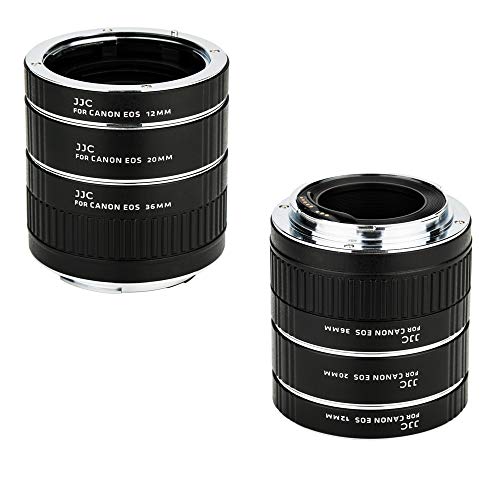
- Includes 12mm, 20mm, and 36mm tubes
- Works with Canon EOS DSLR and EF/EF-S lenses
- Supports autofocus and automatic exposure
Best For: Entry-level Canon macro photography on a budget
Streamlined Canon EF/EF-S Macro Set

- 12mm, 20mm, and 36mm tubes included
- Maintains autofocus and automatic exposure functions
- Metal mounts and electronic contacts
Best For: Canon DSLR users wanting flexible electronic macro support
Versatile Canon Set – Kenko DG Extension Tube Trio
Kenko Auto Extension Tube Set DG 12mm, 20mm, and 36mm Tubes for Canon EOS AF Mount
Check Price On AmazonFor photographers comparing camera extension tubes for dslr cameras, this Kenko set offers three different tube lengths—12mm, 20mm, and 36mm—for flexible close-up focusing. The tubes contain no optics and are designed to preserve autofocus and TTL auto exposure with most compatible lenses.
Best For: Canon EOS users who want multiple magnification options in one set.
Pros:
- Includes 12mm, 20mm, and 36mm tubes.
- No optics, allowing the attached lens to provide image formation.
- Designed with circuitry and mechanical coupling for autofocus and TTL auto exposure.
Cons:
- The supplied title specifically identifies the Canon EOS AF mount, so mount compatibility should be checked carefully.
- Using different tube lengths changes the working distance and magnification.
This is the most flexible option of the group for users who want to experiment with several extension lengths rather than commit to a single tube.
Compact Sony Option – Meike 10mm and 16mm AF Tubes
This Meike set is a compact choice for photographers seeking camera extension tubes for dslr cameras and compatible Sony NEX or Alpha systems. Its 10mm and 16mm tubes can be used in three combinations, helping with close-ups of flowers, insects, and other small subjects while supporting autofocus.
Best For: Sony NEX and Alpha users who prioritize portability and adjustable extension.
Pros:
- Includes 10mm and 16mm tubes with three combination options.
- Supports autofocus configuration.
- Small and easy to carry for outdoor or hiking use.
Cons:
- The listing includes both Sony and Nikon-related compatibility wording, so buyers should verify the mount before ordering.
- The construction uses an engineering-plastic body with a metal bayonet.
With two lengths and a lightweight design, this set suits users who want a portable way to increase close-up capability without carrying a larger accessory kit.
Simple Canon Macro Upgrade – Movo/Kooka 25mm AF Tube
The Movo/Kooka 25mm tube is a straightforward option for photographers shopping for camera extension tubes for dslr cameras with Canon EF or EF-S lenses. By adding 25mm of extension, it enables closer focusing while retaining automatic focusing and metering passthrough.
Best For: Canon EOS users who prefer one dedicated 25mm macro extension tube.
Pros:
- Provides 25mm of extension for closer focusing.
- Supports automatic focusing and metering passthrough.
- Compatible with Canon EF and EF-S mounts.
- Includes a one-year warranty.
Cons:
- Only one extension length is included.
- The mount is described as economy plastic.
This tube is a practical, uncomplicated pick when a Canon shooter wants a single 25mm solution instead of a multi-piece extension set.
Flexible Sony E-Mount Set – Meike S-AF3A Macro Tubes
For Sony E and FE shooters evaluating camera extension tubes for dslr cameras and interchangeable-lens systems, the Meike S-AF3A provides 10mm and 16mm tubes that can be used separately or stacked. It supports autofocus and all shooting modes, while the notes recommend manual mode for directly controlling shutter speed and exposure.
Best For: Sony E-mount APS-C and full-frame users photographing small, detailed subjects.
Pros:
- Compatible with Sony E-mount APS-C and full-frame cameras.
- 10mm, 16mm, and combined 26mm configurations are available.
- Supports autofocus and all shooting modes.
- Metal bayonet construction with a lightweight, portable design.
Cons:
- Exposure compensation may be required.
- The listing recommends manual mode to control shutter speed directly.
- It does not provide image stabilization.
The separate or stacked-tube design gives Sony users useful flexibility, while the exposure-control guidance is worth keeping in mind for consistent macro results.
Best Metal Build – Fotodiox Canon EF/EF-S Extension Tube Set
The Fotodiox Macro Extension Tube Set is a straightforward option for photographers seeking camera extension tubes for DSLR cameras with Canon EF or EF-S mounts. Its all-metal construction and multiple combinations support different macro effects while avoiding additional optical glass.
Best For: Canon EOS users who want a durable, manually focused extension-tube setup for extreme macro photography.
Pros:
- Compatible with Canon EF and EF-S mounts.
- All-metal construction for a solid feel.
- Multiple combinations allow varied macro effects.
- Does not alter optical quality by adding glass elements.
Cons:
- Manual focus requires careful positioning and adjustment.
- The supplied notes do not identify electronic autofocus support.
- It is not water resistant.
Choose this set when build quality and flexible macro experimentation matter more than automated focusing. Its Canon-specific mount limits compatibility, but it offers a simple, glass-free approach to closer focusing.
Best Nikon Versatility – Meike N-AF1-A Auto Focus Tube Set
The Meike N-AF1-A is a versatile set of camera extension tubes for DSLR cameras using Nikon F-compatible lenses and bodies. Its 12mm, 20mm, and 36mm tubes can be used individually or stacked, while electronic contacts support autofocus in suitable configurations.
Best For: Nikon DSLR photographers who want several magnification options and electronic focusing support for macro work.
Pros:
- Includes 12mm, 20mm, and 36mm tubes.
- Seven combinations provide different magnification options.
- Supports Nikon AF, AF-S, D, G, and VR lens series.
- Can support autofocus when used individually or in smaller combinations.
Cons:
- Autofocus may be difficult when all three tubes are stacked.
- Manual focus is recommended with the full 66mm combination.
- Uses engineering plastic with metal bayonets rather than all-metal construction.
This is a strong choice for Nikon users who value configuration flexibility. The electronic design adds convenience, but stacking all three rings can make focusing challenging and may require manual control.
Best Nikon Compatibility – Mcoplus Extnp Auto Focus Tube Set
The Mcoplus Extnp set offers three camera extension tubes for DSLR cameras with Nikon AF, AF-S, DX, or FX compatibility. The 12mm, 20mm, and 36mm tubes can transform a standard lens for close-up photography and work separately or in combination.
Best For: Nikon DSLR owners who need broad camera compatibility and adjustable macro magnification.
Pros:
- Compatible with Nikon AF, AF-S, DX, and FX SLR cameras.
- Includes 12mm, 20mm, and 36mm tubes.
- Supports individual or combined use.
- Offers autofocus when used at an appropriate 1–3cm focusing distance.
Cons:
- Autofocus can be difficult with all three tubes installed.
- Close focusing requires a limited working distance.
- The product notes recommend manual focus to avoid blurry results in some setups.
With wide Nikon DSLR compatibility and three extension lengths, this set is practical for experimenting with different magnifications. Expect to fine-tune distance carefully, especially when stacking the tubes.
Flexible Canon Macro Control – VILTROX DG-C Extension Tube Set
For photographers comparing camera extension tubes for DSLR cameras, the VILTROX DG-C offers three lengths—12mm, 20mm, and 36mm—for close-up work with Canon EF and EF-S lenses. The tubes can be used individually or in combinations, while electronic contacts support autofocus and exposure communication.
Best For: Canon DSLR users who want multiple magnification options and broad EF/EF-S compatibility.
Pros:
- Includes 12mm, 20mm, and 36mm tubes with seven possible configurations.
- Supports autofocus when using a single tube and maintains electronic signal transmission.
- Metal bayonets, gold-plated contacts, and an interior light-reflection treatment provide a durable design.
Cons:
- Manual focus is suggested when combining tubes, particularly with shorter focal lengths.
- Combining two or three rings is not recommended below 70mm focal length.
This is a versatile option for Canon owners who value configuration flexibility, though close-up setups may require manual focusing and careful lens-length selection.
Budget-Friendly Canon Close-Ups – JJC EF/EF-S Macro Extension Tubes
The JJC EF/EF-S set is a practical choice for shoppers seeking camera extension tubes for DSLR cameras without buying a dedicated macro lens. Its 12mm, 20mm, and 36mm tubes shorten a lens’s minimum focusing distance and can be used separately or together with compatible Canon EOS DSLR bodies and EF/EF-S lenses.
Best For: Canon EOS users who want an affordable, flexible introduction to macro photography.
Pros:
- Three extension lengths provide several magnification combinations.
- Designed for Canon EF and EF-S lenses and EOS DSLR cameras.
- Supports autofocus and automatic exposure communication.
- Brass camera and lens mounts are paired with an ABS plastic tube.
Cons:
- The manufacturer recommends manual focus or a tripod with a focusing rail for use after installation.
- The tubes are not water resistant.
With broad Canon compatibility and useful length options, this set suits controlled tabletop or tripod-based macro work, especially when keeping costs below a dedicated macro lens.
Streamlined Canon EF/EF-S Macro Set – VILTROX DG-C Auto Focus Tubes
Photographers looking for camera extension tubes for DSLR cameras can use this VILTROX DG-C set to reduce the minimum focusing distance of Canon EF and EF-S lenses. It includes 12mm, 20mm, and 36mm tubes, with electronic contacts intended to preserve autofocus and automatic exposure functions.
Best For: Canon DSLR photographers who want adaptable close-up magnification with maintained camera-lens communication.
Pros:
- Offers three tube lengths for different magnification levels.
- Individual tubes can be used alone or combined for added versatility.
- Precision-engineered metal mounts and electronic contacts support reliable connections.
- Designed for a wide range of Canon DSLR models using EF or EF-S mounts.
Cons:
- It does not include image stabilization.
- It is not water resistant.
This set emphasizes straightforward compatibility and flexible macro experimentation. It is a sensible match for Canon DSLR owners who want electronic autofocus and exposure support in a multi-length kit.
How We Picked These Camera Extension Tubes for Dslr Cameras
We focused on extension tubes that match common DSLR mounts and provide a practical route into macro photography. The selection includes single tubes and multi-length sets, with emphasis on Canon EF/EF-S and Nikon F compatibility. We also considered electronic contacts, autofocus and metering passthrough, tube construction, listed camera compatibility, and the flexibility offered by multiple extension lengths.
Because extension tubes contain no optics, fit and electronic communication matter more than lens-style features. Always confirm the exact mount and camera generation before ordering, especially when using third-party accessories.
Quick Comparison
| Best For | What to Look For | Typical Advantage |
|---|---|---|
| Flexible macro experimentation | 12mm, 20mm, and 36mm set | Multiple magnification levels |
| Convenient shooting | Electronic contacts | Autofocus and metering support |
| Maximum close-up magnification | Longer extension or stacked tubes | Greater lens-to-subject enlargement |
| Occasional use | Single 25mm tube | Lower cost and simpler setup |
Key Buying Factors for Camera Extension Tubes for Dslr Cameras
Mount and Camera Compatibility
Choose a tube designed for your lens mount, not merely your camera brand. Canon EF and EF-S, Nikon F, Sony E, and other mounts are not interchangeable. Check whether the product supports your specific body and lens combination, including crop-sensor lenses.
Electronic Contacts
Automatic tubes with electrical contacts can preserve lens-camera communication for aperture control, metering, and sometimes autofocus. Manual tubes can be less expensive, but you may need to focus manually and adjust aperture by another method. Autofocus often becomes unreliable at extreme magnifications, so electronic passthrough is useful but not essential for every photographer.
Extension Length and Stacking
Longer extension generally increases magnification but reduces the available focusing distance and light reaching the sensor. Sets with several lengths let you balance magnification and working distance. Stacking tubes can provide more extension, but increases the importance of solid construction and clean, secure connections.
Build Quality and Handling
Look for firm bayonet mounts, reliable release buttons, and minimal play between the lens, tube, and camera. Metal construction can improve durability, while lighter plastic sets may be easier to carry. Avoid forcing a tight connection or using a heavy lens on a poorly supported adapter.
Who Should Buy Which Camera Extension Tubes for Dslr Cameras?
Canon DSLR owners who want flexibility should consider a three-piece EF/EF-S set, while photographers who prefer a simpler setup may find a single 25mm tube easier to use. Nikon DSLR users should prioritize an F-mount set with confirmed AF or AF-S compatibility. Sony users should select an E/FE-compatible model only if their camera is supported, since Sony mount accessories are not substitutes for DSLR-specific Canon or Nikon tubes.
Choose electronic tubes when you regularly photograph moving subjects, change apertures in the field, or want normal metering behavior. Choose a manual set when cost, simplicity, and deliberate tripod-based macro work matter most. Whichever model you select, expect a narrower focus range and plan to move the camera physically to achieve focus.