The best compact MIDI controllers give you hands-on control without taking over your desk or studio bag. This roundup compares 10 portable options for producers, performers, and beginners.
We cover mini keyboards, pad controllers, and hybrid designs, with attention to playability, software control, portability, and value.
Best 10 Compact Midi Controllers Picks for 2026
Best All-Rounder

- 25 velocity-sensitive mini keys and eight MPC pads
- Full-color screen with eight assignable knobs
- USB-C, MIDI Out, and advanced performance modes
Best For: Feature-focused beat makers and portable producers
Best Workflow Controller

- 25 velocity-sensitive keys with 16 RGB pads
- Eight encoders and four faders for hands-on control
- Includes bundled instruments and Ableton Live Lite
Best For: Producers needing keys, pads, faders, and browsing controls
Best Proven Beat-Making Pick

- 25 velocity-sensitive mini keys and eight MPC pads
- Four-way thumbstick and built-in arpeggiator
- Includes MPC Beats and a starter sound library
Best For: Home-studio beat makers and beginner producers
Best Minimalist Option

- Slim 25-key bed in a small USB-powered design
- Two touch strips for expressive control
- Includes 500 presets and Ableton Live Lite
Best For: Mobile musicians and minimalist compact setups
Best Expressive Mini Keyboard

- 25 velocity-sensitive mini keys
- Arpeggiator, sustain, and octave controls
- Eight programmable preset slots
Best For: Expressive portable keyboard performance
Best Slimline Keyboard

- Low-profile 25-key USB-MIDI design
- Velocity-sensitive keys with improved spacing
- Dedicated sustain button
Best For: Slim laptop-based note entry
Best Ableton Clip Controller

- 8x8 RGB pad matrix for clip launching
- Eight assignable faders plus master fader
- Drum and Note modes for Ableton Live
Best For: Ableton Live looping and live mixing
Portable Scale Builder

- 25 keys with smart scale modes and OLED display
- Eight pads plus arpeggio, chord, and note-repeat tools
- USB-C connectivity with included learning and DAW software
Best For: Beginners and mobile producers seeking guided composition tools
Ableton Clip Launcher
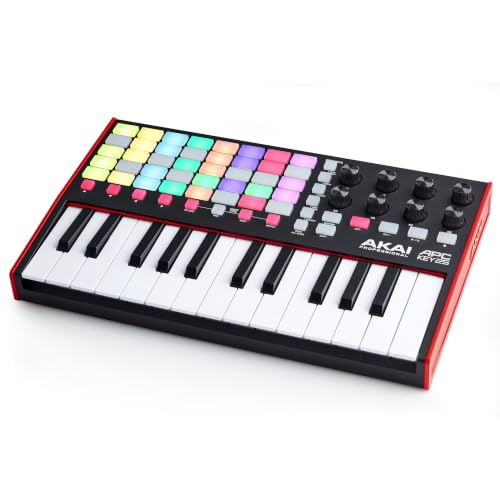
- 25 velocity-sensitive mini keys for melodic parts
- 40 RGB pads designed for Ableton clip launching
- Eight assignable knobs and dedicated session navigation
Best For: Ableton Live performers and clip-based producers
Standalone Sequencing Hub

- 37 keys provide three full octaves of playing range
- CV/Gate and MIDI I/O connect external hardware
- Built-in 64-step sequencer, pads, knobs, and performance modes
Best For: Hybrid producers needing more range and hardware connectivity
Best All-Rounder – Akai MPK Mini IV
The Akai Professional MPK Mini IV is one of the most feature-rich compact midi controllers for beat making, songwriting, and mobile production. Its 25 velocity-sensitive mini keys, MPC pads, screen, knobs, and USB-C connectivity provide substantial hands-on control in a portable format.
Best For: Producers who want an advanced compact controller with strong beat-making and workflow features.
Pros:
- Includes 25 velocity-sensitive keys, eight MPC pads, eight assignable 360-degree knobs, and a full-color display.
- Chord, Scale, and enhanced arpeggiator modes can help generate ideas quickly.
- Offers USB-C, full-size MIDI Out, pre-mapped DAW integration, and a broad software bundle.
Cons:
- Its extensive controls may be more than beginners need.
- Mini keys provide portability but less playing space than a full-size keyboard.
The MPK Mini IV stands out when you want a compact midi controller that can cover keys, pads, plugin control, and DAW navigation without immediately requiring a larger setup.
Best Workflow Controller – Arturia MiniLab 3
The Arturia MiniLab 3 is a practical choice among compact midi controllers for users who want keys, pads, faders, and software browsing in one streamlined unit. Its 25-key layout and hands-on controls are suited to both instrument control and DAW-based production.
Best For: Producers who prioritize versatile controls and an integrated software package.
Pros:
- Provides 25 velocity-sensitive keys, 16 RGB pads, eight rotary encoders, and four faders.
- Includes a clickable browsing knob, mini display, arpeggiator, and touch-based pitch and modulation controls.
- Comes with Ableton Live Lite, Analog Lab Intro, UVI Model D, and a five-year limited warranty.
Cons:
- The controller uses USB connectivity rather than the USB-C connection found on some newer models.
- Its many controls may take time to configure for a personalized workflow.
MiniLab 3 is a well-rounded option for compact setups, particularly if you want more mixing and browsing controls than a basic mini keyboard typically provides.
Best Proven Beat-Making Pick – Akai MPK Mini MK3
The Akai Professional MPK Mini MK3 remains a capable compact midi controller for home studios and beat makers. It combines 25 velocity-sensitive mini keys with MPC-style pads, assignable knobs, a four-way thumbstick, and a built-in arpeggiator.
Best For: Beat makers and first-time producers seeking a compact controller with an established feature set.
Pros:
- Includes eight velocity-sensitive MPC pads with Note Repeat and Full Level functions.
- Eight 360-degree knobs support control of software instruments and effects.
- Comes with MPC Beats, three virtual instruments, 2GB of sound content, and a two-month Splice offer.
Cons:
- Uses an older USB 2.0 Type-B connection.
- It has a one-year manufacturer warranty, shorter than the MiniLab 3’s supplied warranty.
The MPK Mini MK3 is a sensible compact midi controller when dependable beat pads and straightforward plugin control matter more than the newest connection standard.
Best Minimalist Option – Arturia MicroLab Mk3
The Arturia MicroLab Mk3 is a streamlined compact midi controller designed for creating music in tight spaces or on the move. Its 25-key slim keybed, touch strips, USB-C connection, and simple control layout keep the focus on immediate playability.
Best For: Mobile musicians and minimalist producers who want portable keys with essential controls.
Pros:
- Small, lightweight, USB-powered design suits mobile music-making and compact studios.
- Upgraded slim keybed is designed to provide a responsive playing experience.
- Includes two touch strips, 500 Analog Lab Intro presets, Ableton Live Lite, and USB-C connectivity.
Cons:
- Has fewer physical controls than the MPK Mini IV or MiniLab 3.
- The supplied notes do not list drum pads, faders, or MIDI Out.
MicroLab Mk3 is the straightforward choice for players who value a small footprint and quick setup over extensive pad, knob, or mixer-style control.
Best Expressive Mini Keyboard – Akai Professional LPK25
The Akai Professional LPK25 is a practical choice for musicians seeking compact midi controllers with playable, velocity-sensitive mini keys. Its octave controls, sustain button, arpeggiator, and programmable presets make it suitable for songwriting, beat-making, and portable production.
Best For: Producers and keyboard players who want expressive control in a compact USB-powered format.
Pros:
- Velocity-sensitive 25-key mini keyboard supports more expressive playing.
- Includes octave controls, sustain, arpeggiator, and clock functions.
- Eight programmable preset slots support customized DAW and instrument mappings.
- USB-powered plug-and-play setup works with Mac and PC software.
Cons:
- Mini keys may feel limiting for players accustomed to full-size keyboards.
- Provides keyboard control rather than pads or dedicated mixer controls.
The LPK25 stands out when portability and expressive keyboard input matter more than extensive hands-on controls. Its software compatibility and preset storage also make it easy to integrate into an existing setup.
Best Slimline Keyboard – Korg nanoKEY2
The Korg nanoKEY2 is one of the simplest compact midi controllers for laptop-based music making. Its low-profile 25-key design combines velocity sensitivity with an intentionally slim footprint, while the sustain button helps with entering piano parts.
Best For: Laptop musicians who prioritize a thin, straightforward keyboard for note entry and basic performance.
Pros:
- Low-profile 25-key design is easy to place beside a laptop.
- Velocity-sensitive keys are tuned for improved accuracy and response.
- Ample key width and spacing can help reduce wrong notes.
- Dedicated sustain button is useful for piano-style parts.
Cons:
- Offers fewer creative controls than controllers with arpeggiators, pads, or faders.
- Supplied notes identify Ableton Live support but do not list broad software compatibility.
The nanoKEY2 is a sensible minimalist option for entering melodies, chords, and piano parts without adding much bulk. Choose it when a slim keyboard is more important than advanced production features.
Best Ableton Clip Controller – Akai APC Mini MK2
The Akai APC Mini MK2 takes a different approach to compact midi controllers, focusing on clip launching, mixing, and live performance rather than piano-style keys. Its 8×8 RGB pad matrix, nine assignable faders, and Ableton Live integration provide hands-on control for loops, samples, instruments, and mixer settings.
Best For: Ableton Live users who need compact clip launching and live mixing control.
Pros:
- Bright 64-pad RGB matrix provides visual feedback for clip launching.
- Eight assignable faders plus a master fader support hands-on mixing.
- Includes Drum and Note modes with Smart Scale View for melodic playing.
- USB-powered plug-and-play design includes Ableton Live Lite.
Cons:
- Designed around Ableton Live rather than general-purpose keyboard performance.
- Does not provide traditional piano-style keys.
- Its pad-and-fader layout may be more control than needed for simple note entry.
The APC Mini MK2 is the strongest fit here for loop-based production and live Ableton workflows. Its visual pads and dedicated faders offer substantially more performance control than a compact keyboard, provided Ableton Live is your primary DAW.
Portable Scale Builder – Donner DMK 25 Pro
The Donner DMK 25 Pro is a versatile choice among compact midi controllers for mobile and computer-based production. Its 25 keys, smart scale modes, drum pads, OLED display, and USB-C connectivity make it suited to sketching melodies, beats, and arrangements in a small workspace.
Best For: Beginners and mobile producers who want guided composition features and broad software compatibility.
Pros:
- Smart Dynamic Scale Mode with 16 scale options can simplify bass lines, melodies, and leads.
- Includes eight drum pads, arpeggio, note repeat, chord functions, transport controls, and four assignable wheels.
- USB-C adapter supports connection to compatible PCs, phones, and tablets, while included courses help new producers learn.
Cons:
- It does not produce sound independently and requires a computer or mobile device with DAW software.
- Additional adapters may be needed for devices using Micro USB, Lightning, or other interfaces.
The DMK 25 Pro stands out when creative assistance and portability matter more than a traditional piano-style playing experience. Its teaching content and scale tools make it particularly approachable for developing producers.
Ableton Clip Launcher – Akai APC Key 25 MK2
The Akai APC Key 25 MK2 is one of the most focused compact midi controllers for Ableton Live users. It combines 25 velocity-sensitive mini keys with a 40-pad RGB matrix, eight rotary knobs, and dedicated navigation controls for launching clips and shaping sessions.
Best For: Ableton Live performers and producers who prioritize clip launching, visual feedback, and hands-on software control.
Pros:
- Bright 5×8 RGB pad matrix provides 40 pads for launching clips with visual color feedback.
- Pre-mapped 1:1 integration with Ableton Live 11.2.7 and later supports a streamlined workflow.
- Eight assignable knobs, octave buttons, and directional controls provide tactile mixing and session navigation.
Cons:
- The strongest integration is with Ableton Live, so it may be less compelling for users of other DAWs.
- Its two-octave mini-key layout may feel limiting for extended melodic parts without using octave controls.
Choose the APC Key 25 MK2 if live clip launching and Ableton control are central to your setup. It is compact enough for travel while offering more performance-oriented controls than a basic mini keyboard.
Standalone Sequencing Hub – Akai MPK Mini Plus
The Akai MPK Mini Plus expands the compact midi controllers category with 37 keys, giving players three full octaves while retaining a portable format. CV/Gate and MIDI connections, an integrated 64-step sequencer, pads, knobs, and chord and scale modes make it suitable for both computer-based and hardware workflows.
Best For: Producers who need more melodic range and want to connect a controller to modular gear, synthesizers, or external MIDI equipment.
Pros:
- Three-octave, 37-key layout offers more room for melodies and chords than many mini controllers.
- CV/Gate and MIDI I/O support modular gear, sound modules, synthesizers, and other external sources.
- Built-in 64-step sequencer supports drum and melodic or chord tracks, while eight pads and knobs add hands-on control.
Cons:
- It is larger than 25-key alternatives, so it may take more desk or travel space.
- The controller is USB-powered, and computer-free use still requires connection to a production station or compatible hardware.
The MPK Mini Plus is the strongest fit here for producers who do not want to outgrow a two-octave controller quickly. Its broader key range and hardware connectivity make it a flexible centerpiece for hybrid setups.
How We Picked the Best Compact Midi Controllers
We selected these Compact Midi Controllers based on the features that matter most in a small setup: keyboard or pad layout, control flexibility, connectivity, portability, software compatibility, and overall suitability for different workflows. The list includes 25-key models, smaller travel-friendly controllers, a 37-key option, and dedicated pad hardware for clip launching and beat production.
Because compact controllers serve different purposes, there is no single best design for everyone. A keyboard-focused producer may prioritize key feel and octave range, while an Ableton performer may benefit more from an illuminated pad grid and dedicated transport controls.
Quick Comparison
| Best For | Recommended Type | What to Prioritize |
|---|---|---|
| Beginners | 25-key mini keyboard | Simple controls, bundled software, and easy setup |
| Travel | Ultra-compact keyboard | Low weight, USB power, and durable construction |
| Beat-making | Keyboard with pads | Responsive pads, assignable controls, and drum software |
| Live clip launching | Pad controller | Grid layout, visual feedback, and DAW integration |
| More playable range | 37-key controller | Additional octaves, expressive controls, and desk space |
Key Buying Factors for Compact Midi Controllers
Keyboard Size and Playability
Most small keyboard controllers use mini keys, which save space but feel different from full-size keys. A 25-key model is convenient for bass lines, chords, and leads, while a 37-key controller gives you more range before you need to change octaves. If you frequently play two-handed parts, the larger format may be worth the added size.
Controls, Pads, and Workflow
Look for the controls that match your music-making habits. Drum pads are useful for finger drumming and launching samples, knobs help with software instruments and effects, and pitch or modulation controls add expressive performance options. Pad-focused models are often better for clip launching than keyboard-first designs.
Compatibility and Connectivity
USB connectivity is standard, but newer USB-C models may be more convenient with modern computers and tablets. Check whether the controller works with your preferred DAW and whether it includes bundled instruments, effects, or mapping software. Most MIDI controllers are class-compliant, but device-specific features can vary.
Portability and Power
For mobile production, consider dimensions, weight, cable requirements, and build quality. USB-powered controllers are easy to carry, while models with more pads and controls may need additional desk space. Make sure the layout remains comfortable rather than choosing solely by the smallest footprint.
Who Should Buy Which Compact Midi Controllers?
Choose a compact 25-key keyboard if you want a versatile controller for melodies, chords, and basic beat-making. These models are the best all-around choice for bedroom studios, beginners, and producers who move between locations.
Choose an ultra-compact keyboard if portability is your top priority. Smaller controllers fit easily beside a laptop and work well for sketching ideas, though they provide fewer performance controls.
Choose a pad controller if your workflow centers on samples, drum programming, or live clip launching. These controllers can be faster and more intuitive than a keyboard for rhythm-focused performance.
Choose a 37-key model if you want extra range and a more natural playing layout while still avoiding the footprint of a full-size keyboard. It is a strong choice for players who have enough desk space and want fewer octave changes.