Aftertouch lets you shape notes after they are played, adding pressure-sensitive control for expressive leads, pads, basses, and sampled instruments. The right controller can make that expression feel natural while also fitting your preferred workflow.
This roundup compares 10 MIDI controllers and performance tools across compact, full-size, keyboard-focused, and sequencing designs. Consider key feel, aftertouch implementation, software integration, portability, and the controls you use most.
Best 10 Midi Controllers with Aftertouch Picks for 2026
Best All-in-One Sequencer

- 37 velocity-sensitive keys with aftertouch
- Four polyphonic sequencer tracks and drum sequencing
- CV/Gate, MIDI, USB, and extensive hardware connectivity
Best For: Live electronic setups and complex hardware sequencing
Best Polyphonic Aftertouch

- 49 semi-weighted keys with polyphonic and channel aftertouch
- MPE compatibility, arpeggiator, and chord modes
- OLED parameter displays and Ableton Live integration
Best For: Expressive keyboard performance and modern DAW workflows
Best Full-Size Production Controller
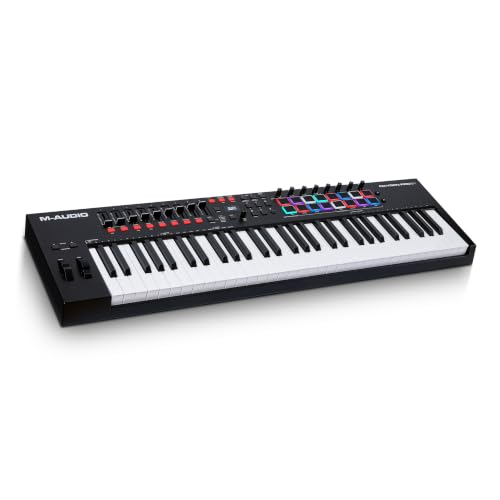
- 61 semi-weighted keys with aftertouch and assignable zones
- 16 pads, eight knobs, and nine faders
- DAW mapping, NKS support, and 5-pin MIDI output
Best For: Studio producers needing keys and extensive hands-on controls
Best Pad-Based Sequencer

- Two melodic sequencers plus a 16-track drum sequencer
- 16 pressure-sensitive pads and 16 sensitive knobs
- USB, MIDI, CV/Gate, and clock connectivity
Best For: Pad-driven beat making and hardware performance setups
Best All-Around Choice

- 16 pads with polyphonic aftertouch
- Major DAW integration
- Scale, Chord, and Arp modes
Best For: Creative producers needing expressive pads and broad DAW control
Best Traditional MIDI Control

- 49 semi-weighted keys with aftertouch
- Nine faders and eight encoders
- USB and traditional MIDI Out
Best For: Keyboard players wanting aftertouch and extensive physical controls
Best for Beat-Making

- 16 velocity-sensitive pads with Note Repeat
- Eight knobs and nine faders
- NKS and software production bundle
Best For: Beat-makers seeking extensive DAW and plugin control
Best Full-Size Control

- 49 keys with aftertouch
- 12 pressure-sensitive pads
- Nine encoders and pedal inputs
Best For: Expressive studio performance and hands-on production
Best Compact Workflow

- 25 velocity-sensitive mini keys
- Eight pressure-sensitive MPC pads
- USB-C, MIDI Out, and DAW controls
Best For: Portable beat making and compact production setups
Best Standalone Sequencing

- 37-key, three-octave layout
- Built-in 64-step sequencer
- CV/Gate and MIDI I/O
Best For: Hardware-focused production and standalone sequencing
Best All-in-One Sequencer – KeyStep Pro 37
The Arturia KeyStep Pro is a strong choice for musicians seeking midi controllers with aftertouch plus deep sequencing and hardware connectivity. Its 37 velocity-sensitive slimkeys combine with four polyphonic sequencer tracks, arpeggiation, drum sequencing, and CV/Gate connections for integrated setups.
Best For: Live performers and electronic musicians building complex hardware, Eurorack, and DAW-based arrangements.
Pros:
- Combines a keyboard controller, arpeggiator, and multitrack sequencer.
- Includes aftertouch, velocity-sensitive keys, chord mode, and touch-strip controls.
- Offers four CV/Gate/Mod outputs, eight drum Gate outputs, MIDI, and USB.
- Supports polyphonic sequencing, pattern chaining, and Scenes mode.
Cons:
- Its extensive sequencing feature set may take time to learn.
- The 37-key slimkey layout may be limiting for players who prefer a full-size keyboard.
The KeyStep Pro stands out when sequencing and connectivity matter as much as expressive keyboard control. It is particularly well suited to performance-focused rigs with multiple synthesizers, drum machines, or modular instruments.
Best Polyphonic Aftertouch – Keystage 49
The Korg Keystage 49 is designed for expressive players who want midi controllers with aftertouch, including polyphonic and channel aftertouch. Its 49-key semi-weighted keybed, MPE compatibility, dedicated OLED displays, and Ableton Live integration support both production and performance.
Best For: Keyboardists who prioritize expressive control, visual feedback, and modern DAW integration.
Pros:
- Provides a 49-key semi-weighted keybed with polyphonic and channel aftertouch.
- Supports MPE for additional expressive control.
- Includes an arpeggiator, chord modes, and parameter-dedicated OLED screens.
- Offers Ableton Live integration, MIDI 2.0 Property Exchange, and bundled software.
Cons:
- Its 49-key format requires more desk space than compact controllers.
- The built-in audio interface and direct stereo output may be more than a basic MIDI setup needs.
The Keystage 49 is a compelling option for players who want polyphonic aftertouch rather than only conventional channel aftertouch. Its semi-weighted keybed and display-focused workflow make it suitable for detailed software control and live playing.
Best Full-Size Production Controller – Oxygen Pro 61
The M-Audio Oxygen Pro 61 combines a 61-key semi-weighted keyboard with aftertouch and a broad set of production controls. For shoppers comparing midi controllers with aftertouch, it adds assignable zones, drum pads, faders, knobs, DAW mapping, and bundled software for a complete computer-based setup.
Best For: Producers who want a full-size keyboard alongside hands-on mixing, beat-making, and plugin control.
Pros:
- Offers 61 velocity-sensitive, semi-weighted keys with aftertouch and assignable zones.
- Includes 16 RGB pads, eight knobs, nine faders, pitch and modulation wheels, and a sustain input.
- Provides Smart Chord, Smart Scale, arpeggiation, and NKS integration.
- Includes a 5-pin MIDI output and a substantial software package.
Cons:
- The 61-key design is relatively large and weighs 10.6 pounds.
- Its numerous controls may be unnecessary for users seeking a simple keyboard controller.
The Oxygen Pro 61 is a practical production hub for musicians who need both expressive keys and physical control over a DAW. Its combination of aftertouch, pads, faders, and software support makes it especially versatile in a studio workflow.
Best Pad-Based Sequencer – BeatStep Pro
The Arturia BeatStep Pro is a compact controller and sequencer for musicians who want aftertouch-equipped performance pads alongside dedicated sequencing tools. It provides two independent melodic sequencers, a 16-track drum sequencer, pressure-sensitive pads, and MIDI/CV/Gate connectivity.
Best For: Beat makers and electronic performers who prefer pad-driven sequencing for hardware and software instruments.
Pros:
- Includes two melodic step sequencers and a 16-track drum sequencer.
- Provides 16 pressure-sensitive pads, 16 sensitive knobs, and transport controls.
- Connects to computers, drum machines, modular synths, and virtual instruments through USB, MIDI, CV, and Gate.
- Adds a touch-strip looper, swing, randomizer, and included music-production software.
Cons:
- It is a pad-and-sequencer controller rather than a conventional piano-style keyboard.
- The compact control surface may require learning its multiple sequencing modes.
The BeatStep Pro is best viewed as a hands-on sequencing centerpiece rather than a traditional keyboard controller. Its pressure-sensitive pads and broad analog/digital connectivity make it a flexible choice for rhythm-focused live rigs and hardware arrangements.
Best All-Around Choice – Novation Launchkey 49 MK4
The Novation Launchkey 49 MK4 is a strong all-around option for musicians seeking MIDI controllers with aftertouch. Its 49 semi-weighted keys are paired with 16 FSR pads featuring polyphonic aftertouch, plus dedicated tools for DAW control, clip launching, chords, scales, and arpeggios.
Best For: Producers who want expressive pads, broad DAW integration, and hands-on creative controls.
Pros:
- 16 responsive pads include polyphonic aftertouch and support drum, clip-launching, and sequencing workflows.
- Works with major DAWs including Ableton Live, Logic, Cubase, Reason, Reaper, FL Studio, and Ardour.
- Includes Scale and Chord modes, an arpeggiator, nine faders, pitch/mod wheels, and an OLED display.
Cons:
- The keyboard has 49 keys, so it may be larger than needed for compact setups.
- Polyphonic aftertouch is specified for the pads rather than the keys.
The Launchkey 49 MK4 stands out for combining expressive pad aftertouch with extensive DAW and performance controls. It is especially compelling if you want one controller for beat-making, arrangement, and melodic production.
Best Traditional MIDI Control – Samson Graphite 49
Samson Graphite 49 Key USB MIDI DJ Keyboard Controller w/Aftertouch/Fader/Pads
Check Price On AmazonThe Samson Graphite 49 is a practical pick among MIDI controllers with aftertouch, offering a 49-key semi-weighted keyboard with aftertouch alongside extensive hands-on controls. It includes programmable faders, encoders, buttons, trigger pads, a display, and both USB and traditional MIDI Out connections.
Best For: Players who want a conventional keyboard controller with aftertouch and physical mixing controls.
Pros:
- 49 semi-weighted keys include aftertouch.
- Nine programmable faders, eight encoders, and 16 buttons provide detailed control of DAWs and virtual instruments.
- Includes four velocity-sensitive trigger pads with two banks, plus USB and MIDI Out connectivity.
Cons:
- Its listed model year is 2012, making it an older design than the other options here.
- The supplied notes list fewer pads than the newer Launchkey and Oxygen controllers.
- The included software information is more limited than the bundled packages offered by the newer models.
The Graphite 49 is notable because aftertouch is specified for its keyboard, not only its pads. Choose it when traditional MIDI Out, programmable controls, and expressive key performance matter more than newer workflow features.
Best for Beat-Making – M-AUDIO Oxygen 49 MKV
The M-AUDIO Oxygen 49 MKV is a versatile choice among MIDI controllers with aftertouch, particularly for producers focused on beats and software instruments. Its 49 velocity-sensitive keys are joined by two banks of eight backlit pads, eight knobs, nine faders, smart performance modes, and NKS integration.
Best For: Home-studio producers who prioritize beat production, plugin control, and bundled software.
Pros:
- Two banks of eight velocity-sensitive pads support beat production, clip launching, and Note Repeat.
- Eight knobs and nine faders offer hands-on control of synths, effects, plugins, and DAW functions.
- Includes NKS integration, Smart Chord and Smart Scale modes, an arpeggiator, and a substantial software bundle.
Cons:
- The supplied notes do not specify aftertouch for the keys or pads, so confirm the exact aftertouch requirements before buying.
- The product details list the number of keys as 1 in one field, despite identifying the controller as a 49-key model.
- Its software and NKS offerings require downloads and setup.
The Oxygen 49 MKV delivers a lot of production control for its size, especially for beat-makers and plugin-heavy workflows. However, shoppers specifically seeking confirmed aftertouch should verify that feature, since it is not clearly stated in the supplied specifications.
Best Full-Size Control – Arturia KeyLab 49 MK3
The Arturia KeyLab 49 MK3 is a strong choice among midi controllers with aftertouch if you want a larger keyboard for expressive playing and hands-on production control. Its 49-key layout combines aftertouch, 12 pressure-sensitive pads, nine assignable encoders, and pedal inputs in a substantial controller.
Best For: Players and producers who want expressive 49-key performance with extensive hands-on controls.
Pros:
- 49 keys with aftertouch for more expressive performances
- Includes 12 pressure-sensitive performance pads
- Nine assignable encoders and sustain/auxiliary pedal inputs expand control
Cons:
- Larger and heavier than compact controllers, weighing 6.2 kg
- USB connectivity is the listed connection method
Choose the KeyLab 49 MK3 when keyboard range and expressive control matter more than portability. It is particularly well suited to a permanent studio or desktop setup.
Best Compact Workflow – Akai MPK Mini IV
The Akai MPK Mini IV is a compact USB-C controller for beat making, portable production, and quick DAW control. While the supplied details emphasize velocity-sensitive mini keys rather than aftertouch, it offers pressure-sensitive MPC pads, eight assignable knobs, a display, and chord, scale, and arpeggiator tools.
Best For: Beat makers, beginners, and mobile producers who prioritize portability and immediate workflow control.
Pros:
- Compact 25-key design with USB-C connectivity
- Eight velocity- and pressure-sensitive MPC pads with RGB feedback
- Includes eight assignable knobs, display, chord/scale modes, and arpeggiator functions
- Supports Mac, PC, and mobile setups with MIDI Out
Cons:
- 25 mini keys provide less playing range than larger controllers
- The supplied notes do not specify keyboard aftertouch
The MPK Mini IV is best viewed as a portable production hub rather than a dedicated aftertouch keyboard. Its pads, software integration, and compact controls make it practical for travel and beat-focused sessions.
Best Standalone Sequencing – Akai MPK Mini Plus
The Akai MPK Mini Plus brings a 37-key format, RGB MPC pads, assignable knobs, and deeper hardware connectivity to the midi controllers with aftertouch category. The supplied details do not list keyboard aftertouch, but its built-in 64-step sequencer, MIDI I/O, and CV/Gate connections make it a flexible production controller.
Best For: Producers who need more keys, standalone sequencing, and connections for external or modular gear.
Pros:
- 37-key layout provides three full octaves for melodic and harmonic parts
- Built-in 64-step sequencer supports drum and melody or chord tracks
- CV/Gate and MIDI I/O connect to modular gear, sound modules, and synthesizers
- Includes eight RGB MPC pads, eight assignable knobs, and chord/scale modes
Cons:
- The supplied notes do not specify keyboard aftertouch
- Plastic construction may feel less substantial than metal-bodied controllers
The MPK Mini Plus is a compelling option when sequencing and external-gear connectivity are priorities. Its 37 keys offer a useful middle ground between compact portability and a more playable keyboard range.
How We Picked the Best Midi Controllers with Aftertouch
We evaluated these controllers by looking at their expressive control options, keyboard or pad layout, connectivity, sequencing features, portability, and suitability for different production setups. Because aftertouch is not implemented identically across every model, we also considered whether a controller is best suited to sustained keyboard playing, live performance, beat making, or hardware-based sequencing.
The selection includes full-size keyboards such as 49- and 61-key models, compact 25- and 37-key options, and specialized controllers built around sequencing or pad performance. Not every product offers the same combination of traditional keyboard aftertouch, polyphonic aftertouch, or performance controls, so verify the manufacturer’s specifications before buying.
Quick Comparison
| Controller type | Best for | What to prioritize |
|---|---|---|
| 25–37 keys | Portable setups and smaller desks | Compact controls, useful pads, and reliable USB connectivity |
| 49–61 keys | Studio production and two-handed playing | Key feel, pitch and modulation controls, faders, and DAW integration |
| Sequencer-focused | Live hardware performance | Track count, pattern workflow, MIDI, CV, and drum sequencing |
| Polyphonic-aftertouch models | Detailed chord and note expression | Per-note pressure response and compatible instruments |
Key Buying Factors for Midi Controllers with Aftertouch
Aftertouch Type and Response
Channel aftertouch applies pressure data across the currently held notes, while polyphonic aftertouch can send separate pressure information for individual notes. Polyphonic aftertouch offers more precise control, but it may cost more and requires compatible software or hardware. Also check whether the pressure curve feels sensitive enough for your playing style.
Key Count and Key Action
Twenty-five or 37 keys are easier to transport and work well for bass lines, leads, and compact arrangements. A 49-key controller provides a useful middle ground, while 61 keys are better for extended two-handed parts. Semi-weighted keys can feel more substantial; synth-style actions are often faster for electronic performance.
Controls and Workflow
Look for the controls you will actually use: pads, knobs, faders, transport buttons, arpeggiators, chord modes, and dedicated sequencing controls. Deep DAW integration can reduce setup time, while MIDI and CV connections are valuable if you use external instruments or modular gear.
Software, Power, and Portability
Confirm compatibility with your computer, preferred DAW, and virtual instruments. USB bus power is convenient, but hardware-heavy setups may benefit from additional MIDI or power options. Measure your available desk space and account for the controller’s weight before choosing a larger model.
Who Should Buy Which Midi Controllers with Aftertouch?
Choose a Compact Controller If Space and Portability Matter
Musicians who travel, produce in small spaces, or mainly play basses and leads should consider a 25- or 37-key model. These options are easier to carry while still providing expressive control and essential performance features.
Choose a 49- or 61-Key Controller for Studio Versatility
Producers who play two-handed parts, arrange orchestral sounds, or want more physical mixing controls will usually prefer a larger keyboard. These models offer a more familiar playing range and leave less need for octave switching.
Choose a Sequencer-Focused Model for Hardware Performance
If your setup centers on drum machines, synthesizers, or modular equipment, a dedicated sequencer can be more useful than a conventional keyboard controller. Prioritize independent tracks, pattern control, MIDI routing, and CV compatibility.
Choose Polyphonic Aftertouch for Maximum Note-Level Expression
Players working with expressive synthesizers, evolving pads, and modern software instruments should consider polyphonic-aftertouch support. It is especially valuable when you want to vary individual notes within a chord rather than applying one pressure value to the entire performance.