Choosing the right amplifier for bi-amping can improve system flexibility, power distribution, and control over separate high- and low-frequency speaker sections. The challenge is matching amplifier output, speaker requirements, and connection options without paying for power you cannot use.
We compare 10 power amplifiers for bi-amping across home stereo, desktop, and PA applications, including compact Class D designs, Bluetooth-enabled models, and higher-output two-channel amplifiers.
Best 10 Power Amplifiers for Bi Amping Picks for 2026
Compact HiFi Choice

- 300W per channel from a TPA3255 design
- RCA input with bass and treble controls
- Compact 2-channel amp for 2-8 ohm speakers
Best For: Compact home-audio systems and bookshelf speakers
Balanced High-Power Option

- 200W output with selectable high/low gain
- XLR balanced connection for system integration
- 12V trigger supports linked power control
Best For: High-power separates systems using balanced connections
DIY Wireless Build

- 220W per channel from dual TPA3251 chips
- Bluetooth 5.2, AUX, and USB connectivity
- Built-in protection and adjustable tone controls
Best For: DIY wireless speaker and custom amplifier projects
Rackmount PA Workhorse

- 2-channel, 2U rackmount design for live sound
- XLR, 1/4-inch, RCA, Speakon, and binding-post connections
- Protection circuits, limiter, and variable-speed cooling
Best For: Mobile DJ rigs, PA systems, and fixed installations
Best Compact Choice

- Four-channel output for four passive speakers
- Independent volume controls for two speaker pairs
- Bluetooth, USB, SD/MMC, AUX, and RCA inputs
Best For: Compact home theater and desktop audio setups
Best Professional Power
MUSYSIC SYS-2000 2-Channel Amp

- 2000W peak two-channel rack-mount design
- XLR and 1/4-inch inputs for professional setups
- 10Hz–50kHz response with stated sub-0.1% THD
Best For: DJs, live sound, studios, and high-output passive speakers
Best Flexible Rack Amp
Pyle PTA1000BT Bridgeable Amplifier

- 1000W per channel stereo or 2000W bridged
- TRS, XLR, Speakon, and binding-post connections
- Bluetooth, USB-A playback, cooling fan, and LED meters
Best For: Rack systems needing flexible stereo or bridged operation
Compact Class D Pick
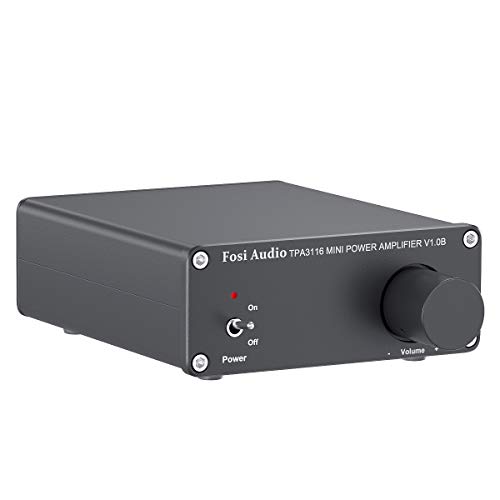
- Two-channel Class D design rated at 50W x 2
- TPA3116D2-based circuitry with speaker protection
- Compact aluminum chassis and included 19V supply
Best For: Small home audio systems and straightforward stereo amplification
Flexible Rack-Ready Option

- 100W x 2 RMS output with 225W bridged mode
- Stereo, parallel, and bridge operating modes
- Bluetooth 5.3, USB, RCA, AUX, and XLR inputs
Best For: Versatile home, DJ, garage, and small live sound systems
Compact HiFi Choice – Fosi Audio TB10D
If you need power amplifiers for bi amping in a compact home-audio setup, the Fosi Audio TB10D offers two channels, up to 300 watts per channel, and straightforward RCA connectivity. Its bass and treble controls also make quick sound adjustments easy.
Best For: Home listeners who want a small, flexible amplifier for passive bookshelf speakers and everyday audio sources.
Pros:
- TPA3255-based two-channel design rated at 300 watts per channel
- Supports passive speakers from 2 to 8 ohms
- RCA input, passive speaker output, and bass/treble controls
- Compact design with built-in protection circuits
Cons:
- Only one RCA input is listed
- Power adapter and other system components may be needed separately
- Its home-audio format may be less suitable for rack-based installations
The TB10D is a practical choice when space and simple controls matter. For a bi-amping system, you would need a second amplifier and suitable source or crossover equipment, but this unit provides a capable two-channel foundation.
Balanced High-Power Option – LEAUDIO TOPPING B200
For power amplifiers for bi amping in a more advanced system, the LEAUDIO TOPPING B200 emphasizes 200-watt output, balanced XLR connectivity, selectable gain, and a 12V trigger. Those features make it easier to integrate into a coordinated separates setup.
Best For: Audiophiles building a high-power, balanced system with a compatible preamp or DAC.
Pros:
- 200-watt output for a wide range of speakers
- High- and low-gain options for system matching
- XLR balanced connection supports stable signal transmission
- 12V trigger enables linked power control
Cons:
- The notes do not specify speaker-output or input details beyond the listed XLR connection
- Its benefits are greatest with compatible separates such as the Pre90 or D90 III SABRE
- A bi-amping setup requires two amplifiers and additional system hardware
The B200 is a strong fit for a deliberate separates system rather than a casual all-in-one setup. Its gain choices and trigger input are particularly useful when coordinating multiple amplifiers for bi-amping.
DIY Wireless Build – DAMGOO T220HS Amplifier Board
Among power amplifiers for bi amping, the DAMGOO T220HS stands out as a DIY board rather than a finished enclosure. It provides two 220-watt channels, Bluetooth 5.2, AUX, USB functions, and independent tone controls for custom speaker projects.
Best For: DIY builders creating wireless stereo speakers or custom bi-amping hardware.
Pros:
- 220 watts per channel with dual TPA3251 chips
- Bluetooth 5.2, AUX, USB sound card, and USB flash-drive support
- Independent bass, treble, and multifunction volume controls
- Protection against short circuit, voltage issues, overheating, and clipping
Cons:
- Power adapter is not included
- Requires DIY installation and a suitable enclosure or project setup
- Only two channels are provided, so a complete bi-amping system needs additional hardware
This board offers considerable flexibility for experienced builders, but it is not a plug-and-play amplifier. Confirm the required supply voltage, enclosure, wiring, and crossover arrangement before using it in a bi-amping project.
Rackmount PA Workhorse – Gemini XGA-2000
If your power amplifiers for bi amping need to serve a live-sound or installation system, the Gemini XGA-2000 offers a rack-ready two-channel format, balanced and unbalanced inputs, bridge mode, and multiple speaker outputs. Its protection and cooling features suit demanding operation.
Best For: Mobile DJs, PA systems, and fixed installations that need a rugged 2U amplifier with flexible connections.
Pros:
- Two-channel amplifier with stated 2000-watt output
- XLR, 1/4-inch, and RCA inputs accommodate varied sources
- Speakon outputs and binding posts support different speaker connections
- DC, short-circuit, limiter, and thermal-management features
Cons:
- Its 17.6-pound, 2U rack format is less suited to compact home systems
- Fan cooling may be audible in quiet listening rooms
- Bi-amping requires appropriate crossover equipment and a second amplifier or channel arrangement
The XGA-2000 is the most installation-oriented option in this group. Stereo and mono-bridge modes, status LEDs, and rack mounting make it practical for high-output systems, though its PA-focused design may be excessive for small home speakers.
Best Compact Choice – S-299 Bluetooth 5.0 Power Amp
If you need power amplifiers for bi amping in a compact home setup, the S-299 is worth considering for its four-channel layout and separate speaker-pair volume controls. It supports four 4–8-ohm passive speakers at a rated 40W x 4 and can also connect to an active subwoofer, although its 12V/5A power design is intended for modest systems rather than high-output professional use.
Best For: Home theater, desktop audio, or distributed listening setups using two independently controlled speaker pairs.
Pros:
- Four-channel design supports four passive speakers and an active subwoofer.
- Independent volume controls adjust speaker pairs A/B and C/D separately.
- Bluetooth 5.0, USB, SD/MMC, AUX, and RCA inputs offer flexible source options.
- Compact 5.3 x 6.9 x 1.7-inch design includes a remote control.
Cons:
- Rated output is 40W x 4, so it is not suited to demanding large-room systems.
- Bluetooth operating range is limited to about 5 meters.
- It requires a 12V DC power supply and is not a conventional rack-mount amplifier.
The S-299 is the most approachable option here for a small bi-amping-style or multi-zone experiment, particularly when Bluetooth and compact size matter. Verify your speaker impedance, crossover arrangement, and power needs before buying.
Best Professional Power – MUSYSIC SYS-2000 2-Channel Amp
For power amplifiers for bi amping in a larger or more demanding system, the MUSYSIC SYS-2000 provides a rack-mountable two-channel platform with 2000W peak output. Its XLR and 1/4-inch inputs, 10Hz–50kHz frequency response, and stated sub-0.1% THD make it better suited to professional speaker systems than compact consumer amplifiers.
Best For: DJs, live performers, studios, and listeners building a high-output two-amplifier or professional passive-speaker system.
Pros:
- Two-channel design and 2000W peak output provide substantial system expansion capacity.
- ATR Technology is designed for fast response to demanding bass transients.
- Professional connections include XLR and 1/4-inch inputs.
- Rack-mountable 2U aluminum chassis includes thermal protection.
Cons:
- The supplied specifications emphasize peak output, so confirm continuous power requirements before matching speakers.
- At 19 x 12 x 4 inches and 13 pounds, it needs dedicated rack or shelf space.
- It lacks the built-in Bluetooth and media-player features found on some consumer-oriented options.
The SYS-2000 is the strongest fit when bi-amping calls for professional connectivity, rack integration, and substantial headroom. Pair it with speakers and a crossover whose impedance and power demands match the amplifier’s specifications.
Best Flexible Rack Amp – Pyle PTA1000BT Bridgeable Amplifier
The Pyle PTA1000BT is a practical candidate among power amplifiers for bi amping because its two channels can operate in stereo or bridge mode. It delivers up to 1000W per channel in stereo or 2000W bridged, while TRS and XLR inputs, Speakon outputs, binding posts, and Bluetooth make it easy to adapt to different speaker and source configurations.
Best For: Rack-based home or event systems that need selectable stereo/bridged operation and multiple connection types.
Pros:
- Supports 1000W per channel in stereo or 2000W maximum in bridged mode.
- Works with multiple speakers rated from 4–8 ohms.
- Offers TRS, XLR, Speakon, and binding-post connections.
- Includes Bluetooth, USB-A MP3 playback, LED meters, and a built-in cooling fan.
Cons:
- Two channels may require an additional amplifier for a complete multi-band bi-amping system.
- Its 19.09 x 9.84 x 3.54-inch rack format is less convenient for portable or small-room use.
- The supplied notes specify maximum output rather than continuous RMS output.
The PTA1000BT stands out for connection flexibility and its stereo-to-bridgeable design. It is a sensible choice when your system may change between two-channel operation and higher-output bridged use, provided the speakers and crossover are configured for the selected mode.
Compact Class D Pick – Fosi Audio V1.0B
The Fosi Audio V1.0B is a compact two-channel option for power amplifiers for bi amping setups where you want a simple, efficient stereo amplifier. Its Class D design, included 19V power supply, and 50W x 2 rating make it suitable for compatible home speaker systems, provided your bi-amping arrangement uses separate amplifier channels and the required external crossover or speaker controls.
Best For: Home audio users seeking a small, low-noise stereo amplifier for compatible bi-amping experiments.
Pros:
- Two-channel Class D design with 50W x 2 output rating
- Uses two Texas Instruments TPA3116D2 chips
- Built-in speaker protection and solid aluminum chassis
- Includes a 19V power adapter, AC cord, and manual
Cons:
- Only two amplifier channels, so a second amplifier may be needed for a conventional stereo bi-amping setup
- Supplied notes do not mention Bluetooth, USB, or tone controls
- Compatibility depends on your speakers’ crossover and impedance requirements
Choose the V1.0B when compact size, efficient operation, and a straightforward analog-style stereo setup matter most. For bi-amping, verify the speaker terminals, crossover arrangement, and power needs before buying.
Flexible Rack-Ready Option – Donner MAMP7
The Donner MAMP7 stands out among power amplifiers for bi amping if you need more inputs and flexible operating modes. It provides two 100W RMS channels, supports 4–8-ohm speakers, and can run in stereo, parallel, or bridge mode. Because bi-amping requirements vary, confirm that the selected mode and speaker connections match your system before installation.
Best For: Home parties, small live sound systems, DJs, and users who need a versatile two-channel amplifier with multiple inputs.
Pros:
- Delivers 100W x 2 RMS or 225W x 1 in bridge mode
- Offers stereo, parallel, and bridge input modes
- Includes Bluetooth 5.3, USB, RCA, AUX, and XLR inputs
- Provides treble, midrange, and bass controls plus rack-friendly 2U sizing
Cons:
- Bridge mode is not the same as a two-channel bi-amping configuration
- Its fan and rack-style design may be more than a simple home setup needs
- Power output and speaker compatibility should be matched carefully
The MAMP7 is the most adaptable choice here for systems that value input variety, output headroom, and flexible modes. For bi-amping, use its two channels only in a configuration supported by your speakers and crossover equipment.
Desktop Wireless Pick – Nobsound Mini Bluetooth Amp
The Nobsound mini amplifier is a convenient choice among power amplifiers for bi amping when desktop size and flexible source connections are priorities. It offers two channels rated at 50W x 2, with Bluetooth 5.0, USB, and AUX inputs. Its compact form makes it easy to place, but a complete bi-amping system may require another amplifier and suitable external crossover equipment.
Best For: Desktop, office, and small home audio systems needing wireless and USB playback in a compact enclosure.
Pros:
- Compact aluminum enclosure measuring about 2.76 x 3.07 x 1.5 inches
- Two-channel 50W x 2 output rating
- Supports Bluetooth 5.0, USB, and AUX inputs
- Includes a 19V supply, AUX/USB/RCA cables, and manual
Cons:
- Its compact two-channel design may require a second amp for full stereo bi-amping
- Supplied notes do not identify dedicated bi-amping controls or an internal crossover
- Small-format output should be matched to the speakers and listening demands
The Nobsound is best viewed as a compact source-friendly amplifier rather than a dedicated bi-amping controller. It makes sense for desktop systems or modest speaker projects where Bluetooth and USB convenience are as important as amplifier size.
How We Picked the Best Power Amplifiers for Bi Amping
We evaluated these amplifiers by focusing on the specifications that matter when separate amplifier channels drive a speaker’s high- and low-frequency sections. Our comparison considered channel count, claimed power ratings, impedance compatibility, input and output options, size, wireless connectivity, controls, and intended use.
Because manufacturers may measure wattage under different conditions, power figures should be treated as a starting point rather than a direct performance ranking. A suitable amplifier should provide clean, stable output at your speakers’ nominal impedance and leave reasonable headroom for musical peaks.
Quick Comparison
- Compact home and desktop systems: Mini Class D models are easy to place and typically offer Bluetooth, AUX, or USB connectivity.
- Higher-output stereo setups: Larger two-channel amplifiers are better suited to demanding speakers or rooms requiring more headroom.
- PA and installation use: Rack-mount models with XLR, TRS, Speakon, or bridgeable operation provide more deployment flexibility.
- Custom builds: Amplifier boards can suit DIY projects, but they require an appropriate power supply, enclosure, cooling, and safe wiring.
Key Buying Factors for Power Amplifiers for Bi-Amping
Power, Impedance, and Headroom
Check your speakers’ recommended amplifier range and impedance before choosing a model. For bi-amping, confirm that both amplifier channels can handle the intended high- and low-frequency loads. Avoid relying solely on peak or marketing wattage; RMS output at the relevant impedance is more useful.
Active Versus Passive Bi-Amping
Passive bi-amping uses the speaker’s internal crossover, while active bi-amping places the crossover before the amplifiers. Active setups require compatible crossover equipment and careful frequency, phase, and level adjustments. Make sure the amplifier’s gain structure works with the rest of your system.
Connections and System Compatibility
Match the amplifier’s inputs to your source or preamp. RCA and AUX are common for home systems, while XLR and TRS are useful in pro-audio environments. Bluetooth is convenient, but wired inputs are generally preferable for critical listening. Also verify speaker terminals, Speakon connectors, and whether bridging is appropriate for your speakers.
Cooling, Noise, and Controls
Class D amplifiers are often compact and efficient, but ventilation is still important. Consider fan noise in a listening room, available tone or EQ controls, protection circuitry, and whether each channel can be adjusted independently.
Who Should Buy Which Power Amplifiers for Bi Amping?
Choose a compact mini amplifier for bookshelf speakers, desktop audio, or a simple secondary system where size and convenience matter most. Choose a higher-powered two-channel model if your speakers are less sensitive, your room is larger, or you want more dynamic headroom. Choose a rack-mount PA amplifier for live sound, installations, or systems that need professional connectors and robust output. Choose an amplifier board only if you are comfortable designing the surrounding power, cooling, enclosure, and connection setup.
Before buying, confirm that your speakers support the chosen bi-amping method, remove or separate the correct crossover links when required, and set gain levels carefully. The best result comes from system compatibility—not simply the largest wattage number.