A phono preamp with a headphone jack can simplify a vinyl setup by combining cartridge signal boosting, RIAA equalization, and private listening in one compact component.
We selected 10 models ranging from affordable mini preamps to tube-equipped units with tone controls, gain options, and MM/MC compatibility. The right choice depends on your cartridge, headphones, system connections, and preferred sound.
Best 10 Phono Preamp with Headphone Jack Picks for 2026
Best All-Around Value

- MM phono input with RIAA-compliant circuitry
- 3.5mm headphone and RCA outputs
- Includes grounding post and 12V adapter
Best For: Vinyl listeners needing compact speaker and headphone connectivity
Simple Analog Setup

- RCA left/right input and output
- Dedicated ground terminal
- Power adapter included
Best For: Basic RCA-based turntable systems without a headphone requirement
Best Grounding Flexibility
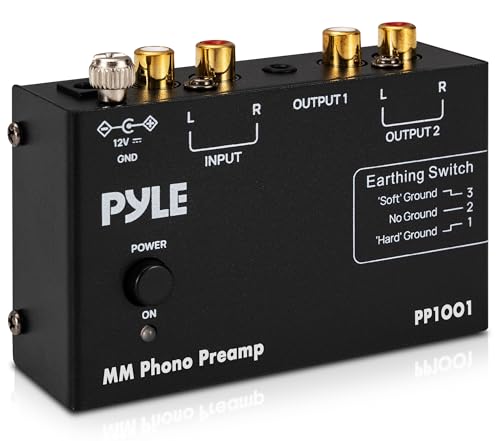
- MM input with RIAA-standard playback
- RCA and 3.5mm headphone outputs
- Selectable hard, soft, or no grounding
Best For: Home vinyl systems needing flexible grounding and headphone access
Best Tube Pick
Douk Audio T12 MM/MC Tube Phono Preamp

- MM and MC turntable support
- 3.5mm headphone output
- Tone controls and dual RCA outputs
Best For: Vinyl listeners seeking tube styling and flexible connections
Best Adjustable-Gain Option
Fosi Audio Box X2 Tube Phono Preamp

- Three selectable gain modes
- Warm tube preamp design
- Supports several replacement tube types
Best For: MM turntable owners who want gain and tube-swapping flexibility
Best Everyday Value
Compact MM Phono Preamp with Headphone Output

- Built-in 3.5mm headphone output
- Front power and volume controls
- Metal casing with gold-plated RCA connections
Best For: Simple MM vinyl setups needing speaker and headphone connectivity
Best with Extra Features
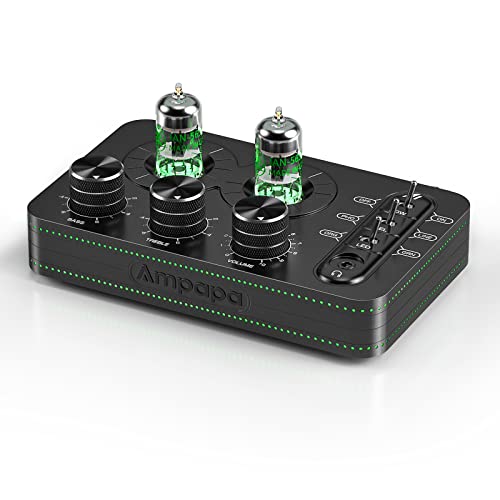
- Warm JAN 5654 tube sound
- Headphone output and tone controls
- Compact aluminum enclosure
Best For: MM turntable listeners wanting adjustable, warm-sounding headphone playback
Best EQ Flexibility
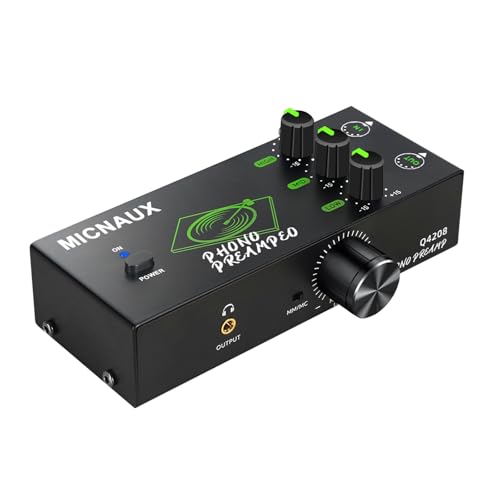
- Supports MM and MC cartridges
- Three-band ±15dB EQ
- 3.5mm headphone and DIN connections
Best For: Vinyl listeners needing cartridge flexibility and extensive tone adjustment
Best for Tube Features
Douk Audio T9 Tube Phono Preamp

- MM/MC support with RCA input
- 16–300Ω headphone amplifier
- Replaceable tubes and magic-eye display
Best For: Tube-audio enthusiasts wanting flexible headphone and turntable connectivity
Best All-Around Value – Fosi Audio Box X1
If you want a practical phono preamp with headphone jack, the Fosi Audio Box X1 combines MM turntable support, RCA output, and a 3.5mm headphone output in one compact unit. Its RIAA-compliant circuitry, grounding post, and included 12V power adapter make it a straightforward choice for everyday vinyl playback.
Best For: Vinyl listeners who need both speaker and headphone connectivity from a compact MM phono preamp.
Pros:
- Provides RCA line output and 3.5mm headphone output for flexible listening.
- Uses low-noise circuitry with RIAA-standard frequency response.
- Includes a grounding post and 12V power adapter.
- Rugged anodized steel housing and an 18-month manufacturer warranty.
Cons:
- Supports MM turntables rather than a broader range of cartridge types.
- It has one channel according to the listed specifications.
The Box X1 is a well-rounded option when simultaneous RCA and headphone output matters. It focuses on simple setup, stable performance, and useful connections rather than advanced adjustments.
Simple Analog Setup – ART DJPREII
The ART DJPREII is a straightforward phono preamp for turntable systems that need RCA connectivity and a dedicated grounding terminal. Its compact design and included power adapter suit basic home audio setups where simple signal conversion is the priority.
Best For: Users building a conventional RCA-based turntable system with an uncomplicated phono preamp.
Pros:
- Offers RCA-type left and right inputs and outputs.
- Includes a ground terminal for turntable connection.
- Comes with a power adapter.
- Compact 4.5-by-4.6-by-1.85-inch listed dimensions.
Cons:
- The supplied notes do not list a headphone output.
- The available specifications provide limited detail about sound performance and controls.
This model is best considered for buyers who value a basic RCA phono stage and do not specifically require a headphone jack. Confirm your connection needs before choosing it for private listening.
Best Tube Design – Douk Audio T4 PRO
For listeners seeking a tube-based phono preamp with headphone jack, the Douk Audio T4 PRO pairs MM phono input with a 3.5mm headphone output and a built-in headphone amplifier. Its included JAN5654 tubes and pluggable sockets also allow tube rolling for buyers who want to explore different sound signatures.
Best For: Vinyl enthusiasts who want tube styling, headphone amplification, and adjustable tube-based sound character.
Pros:
- Combines MM phono input with a 3.5mm AUX input.
- Built-in headphone amplifier is rated for 32–300-ohm headphones.
- Includes JAN5654 tubes and pluggable sockets for tube rolling.
- Compact aluminum chassis with smooth multi-level gain adjustment.
Cons:
- Tube operation may be less appealing to listeners seeking a purely solid-state design.
- Its headphone output is rated at 150mW at 32 ohms, so matching remains important.
The T4 PRO stands out for combining phono conversion, auxiliary input, and headphone amplification in a small enclosure. It is a particularly flexible choice for listeners who enjoy a vintage tube presentation and hands-on sound shaping.
Best Grounding Flexibility – Pyle PP1001
The Pyle PP1001 is a compact phono preamp with headphone jack designed for MM turntables. It provides RCA and 3.5mm outputs, RIAA-standard playback, and a selectable grounding switch intended to help manage hum or buzz in different home audio setups.
Best For: Home listeners who want simple MM turntable connectivity with both RCA and headphone outputs.
Pros:
- Supports MM cartridges and RIAA-standard playback.
- Includes RCA line and 3.5mm headphone outputs.
- Grounding post offers hard, soft, and none settings.
- Compact metal housing is suited to home studios or living rooms.
Cons:
- The supplied notes do not specify headphone output power or supported impedance.
- It is intended for MM inputs rather than broad cartridge compatibility.
- Only a one-year warranty is listed.
With its selectable earthing options and dual output types, the PP1001 is a practical fit for systems where grounding flexibility matters. It keeps the feature set focused on accessible vinyl playback and easy installation.
Best Tube Pick – Douk Audio T12 MM/MC Tube Phono Preamp
If you want a phono preamp with headphone jack that also adds visual character to your setup, the Douk Audio T12 combines MM/MC phono support, a tube stage, tone controls, and a 3.5mm headphone output in a compact walnut enclosure.
Best For: Vinyl listeners who want MM/MC flexibility, adjustable tone, tube styling, and convenient late-night headphone listening.
Pros:
- Supports both MM and MC turntable setups.
- Includes a 3.5mm headphone output for personal listening.
- Offers bass and treble adjustment up to ±10dB.
- Provides dual RCA outputs for two amplifier or powered-speaker systems.
Cons:
- The retro walnut-and-tube design may not suit minimalist systems.
- Its 3.5mm headphone output may be less convenient for listeners using larger headphone plugs.
The T12 stands out when aesthetics and versatility matter as much as basic phono conversion. Its MM/MC compatibility and output switching make it a flexible choice for a growing vinyl system.
Best Adjustable-Gain Option – Fosi Audio Box X2 Tube Phono Preamp
The Fosi Audio Box X2 is a compact phono preamp with headphone jack alternative for listeners who want a tube-based MM phono stage with selectable gain. It converts phono signals to line level and includes a 3.5mm AUX input for use as a tube preamp.
Best For: MM turntable owners who want selectable gain and the ability to experiment with compatible replacement tubes.
Pros:
- Provides three switchable gain modes: 39, 42, and 45dB.
- Uses a tube preamp design intended to produce a warm, smooth sound.
- Includes a grounding post and low-noise integrated circuits.
- Compatible with several listed replacement tube models.
Cons:
- It is designed for MM turntables rather than MM/MC flexibility.
- The supplied notes do not list a headphone output, so it is not a direct fit for dedicated headphone listening.
The Box X2 is a practical choice for tuning gain to different MM setups and exploring tube rolling. Choose it when tube character and compact size are more important than an integrated headphone jack.
Best Everyday Value – Compact MM Phono Preamp with Headphone Output
For shoppers specifically seeking a phono preamp with headphone jack, this compact MM model offers straightforward connectivity, front-panel volume control, and a built-in 3.5mm output. It also provides RCA input and output for speakers or amplifiers.
Best For: MM turntable users who want simple volume adjustment and both RCA and headphone listening in a small metal-cased unit.
Pros:
- Includes a built-in 3.5mm headphone output.
- Offers front-mounted power and volume controls.
- Features a grounding rod and stated SNR of at least 68dB.
- Uses gold-plated RCA connections and includes a 12V power adapter.
Cons:
- Supports MM turntables, with no MC compatibility listed.
- Its simple feature set may be less appealing to listeners seeking tube coloration or extensive system switching.
This model is geared toward uncomplicated daily use. The front controls and headphone output make it especially convenient for desktop, bedroom, or small stereo setups where easy access matters.
Best with Extra Features – A1 Vacuum Tube Phono Preamp
If you want a phono preamp with headphone jack that adds a warm, tube-based character to MM turntable playback, the Ampapa A1 combines phono amplification, headphone output, tone controls, and additional line-level source support in a compact metal enclosure.
Best For: MM turntable owners who want warm tube sound, adjustable bass and treble, and headphone listening in a desktop setup.
Pros:
- Supports MM turntables and can drive active speakers, amplifiers, and many headphones.
- JAN 5654 vacuum tubes provide a warm, rich, detailed sound profile.
- Includes bass and treble controls plus 3.5mm and RCA connectivity.
- Compact aluminum housing with selectable warm orange or cool green lighting.
Cons:
- Designed for MM cartridges rather than both MM and MC formats.
- Its tube-oriented sound may not suit listeners seeking a strictly neutral presentation.
The A1 is a strong fit when headphone output and tube coloration matter as much as basic phono amplification. Its tone controls and compact build add flexibility for a small home audio system.
Best EQ Flexibility – Mini Hi-Fi MM/MC Phono Preamp
This phono preamp with headphone jack is a practical choice for vinyl listeners who want broad cartridge compatibility and hands-on sound shaping. Its low-noise circuit, MM/MC switching, three-band EQ, and 3.5mm headphone connection make it adaptable to different record and listening setups.
Best For: Vinyl users who switch between MM and MC cartridges or want independent bass, midrange, and treble adjustment.
Pros:
- Supports both MM and MC cartridges with a convenient switching function.
- Three-band tone controls offer up to ±15dB adjustment for high, mid, and low frequencies.
- Provides stereo analog output, a 3.5mm headphone jack, and 5-pin DIN input/output.
- Low-noise design and grounding connection aim to reduce interference.
Cons:
- Its connectivity includes 5-pin DIN, which may be unnecessary for simpler systems.
- The supplied notes do not specify headphone impedance support or headphone output power.
Choose this model if flexibility is the priority. MM/MC support and substantial three-band EQ adjustment make it more versatile than a basic fixed-output phono stage, especially for listeners who frequently tailor their system’s sound.
Best for Tube Features – Douk Audio T9 Tube Phono Preamp
The Douk Audio T9 is a phono preamp with headphone jack for listeners who want tube styling, MM/MC compatibility, and direct headphone listening. It adds an independent headphone amplifier, bass and treble controls, and a visual magic-eye display to a sturdy desktop design.
Best For: MM/MC turntable owners who want adjustable tube sound, a dedicated headphone amplifier, and a visually distinctive component.
Pros:
- Supports both MM and MC phono cartridges and also accepts RCA sources.
- Independent 3.5mm headphone amplifier is rated for headphones from 16–300Ω.
- Treble and bass controls enable straightforward sound adjustment.
- Features replaceable tube sockets, magic-eye displays, and selectable green or orange backlighting.
Cons:
- At 0.96 kg, it is heavier than a very basic compact phono preamp.
- Its display, lighting, and tube presentation may be more feature-rich than minimalist systems require.
The T9 stands out for combining cartridge versatility with a clearly specified headphone range and replaceable tubes. It is a good match for a desktop vinyl system where both listening flexibility and visual appeal are important.
How We Picked the Best Phono Preamp with Headphone Jack
We focused on features that matter in everyday vinyl listening: cartridge compatibility, phono-stage performance, headphone output convenience, usable volume control, connection options, and overall setup value. The selection includes MM-focused models for straightforward systems, MM/MC units for broader cartridge support, and tube designs for listeners who want a different presentation or added visual appeal.
Because specifications and bundled accessories can vary, confirm the latest manufacturer details before buying. Pay particular attention to whether a model includes a power adapter, which headphone impedance it supports, and whether its output is intended for headphones, an amplifier, or both.
Quick Comparison
| Feature | What to Look For | Best For |
|---|---|---|
| Cartridge support | MM, MC, or MM/MC switching | Matching your current or future cartridge |
| Headphone connection | 3.5mm or 6.35mm output | Private listening without a receiver |
| Controls | Volume, gain, bass, treble, or balance | Fine-tuning comfort and system sound |
| Outputs | RCA line output, headphone output, or both | Using headphones and powered speakers |
| Circuit design | Solid-state or vacuum tube | Clean convenience or tube-style presentation |
Key Buying Factors for a Phono Preamp with Headphone Jack
Cartridge Compatibility
Start with your turntable cartridge. Many compact units are designed for moving-magnet cartridges, while MM/MC models offer more flexibility for lower-output moving-coil cartridges. A preamp that does not support your cartridge type may produce weak, noisy, or poorly balanced audio.
Headphone Output and Volume
Check the connector type and make sure it matches your headphones or that a suitable adapter is included. A dedicated volume control is especially useful when the preamp will be used directly with headphones. High-impedance headphones may need more output power than basic mini units can provide.
Noise, Gain, and Equalization
Phono signals are extremely low-level, so shielding, grounding, and gain quality affect background noise. RIAA equalization is essential for accurate playback. Adjustable gain can help accommodate different cartridges, while bass and treble controls provide flexibility but may add circuitry and complexity.
System Connections and Placement
Confirm that the RCA input and output arrangement suits your setup. If you want to switch between headphones and speakers, look for a model that provides a usable line output alongside its headphone jack. Keep the preamp away from power supplies and other sources of electrical interference, and connect the turntable ground wire when required.
Who Should Buy Which Phono Preamp with Headphone Jack?
Choose a compact MM model if you want an inexpensive, simple solution for a conventional turntable and headphones. Choose an MM/MC preamp if you plan to upgrade cartridges or already use a moving-coil design. Choose a tube model if you value tube styling and flavor and are comfortable with additional heat, tube maintenance, and possible differences in noise performance. Choose a model with tone controls if you frequently adjust recordings or headphones, while listeners seeking the shortest signal path may prefer fewer controls.