Camera flashes with high speed sync help you shoot wide open in bright light, freeze fast action, and keep flash exposure under control at higher shutter speeds.
If you want a dependable speedlite for portraits, events, or travel, this roundup focuses on practical features that matter most: HSS support, TTL accuracy, recycle time, battery options, and system compatibility.
Best 10 Camera Flashes with High Speed Sync Picks for 2026
Canon TTL Round-Head Upgrade

- 1/8000s HSS with TTL/manual control
- Round head with magnetic dome diffuser
- 3000mAh battery, up to 600 flashes
Best For: Canon users who want a round-head flash with HSS and wireless control
Budget Wireless Workhorse

- GN60 manual flash with 22 power steps
- 1/8000s HSS with compatible triggers
- Built-in 2.4G wireless X system
Best For: Budget-conscious users who already have a compatible HSS trigger
Canon E-TTL Speedlite Choice

- Canon E-TTL II with TTL/manual modes
- 1/8000s HSS and second curtain sync
- Li-ion battery with 650 full-power pops
Best For: Canon EOS users wanting TTL, HSS, and a rechargeable battery
Canon HSS Touchscreen Speedlight
Godox V480-C TTL Flash for Canon

- 1/8000s high speed sync for daylight and action
- 2.4G wireless sender/receiver with 32 channels
- 2.0-inch touchscreen and USB-C rechargeable battery
Best For: Canon users who want a compact, wireless HSS speedlite
Magnetic Mini Flash Kit

- TTL and HSS support in a compact flash body
- X5S trigger enables wireless multi-light control
- Magnetic detachable design speeds on/off-camera use
Best For: Sony shooters who want a compact flash with built-in wireless control
GN60 HSS Speedlite
- GN60 output with TTL and 1/8000s HSS
- Built-in 2.4G wireless X system up to 100 m
- Quick lever lock, USB-C, and external power port
Best For: Canon shooters who want a powerful, full-size HSS speedlite
Smart Nikon Hybrid
- TTL and HSS up to 1/8000s
- Built-in 2.4G receiver for wireless control
- Magnetic hotshoe/trigger design for fast switching
Best For: Nikon shooters who want compact wireless flash flexibility
Power Sony Workhorse
- TTL, manual, and 1/8000s HSS support
- 2.4G wireless X system with master/slave use
- Li-ion battery with fast 1.5s recycle time
Best For: Sony shooters who want a reliable battery-powered HSS flash
Feature-Rich Canon Pick

- 76Ws output with 1/8000s HSS
- New UI with TCM switch and LED modeling lamp
- Built-in 2.4G wireless with master/slave support
Best For: Canon shooters who want a powerful feature-packed flash
Canon TTL Round-Head Upgrade – NEEWER Z2-C 76Ws HSS Flash
If you want one of the more feature-rich camera flashes with high speed sync for Canon, the NEEWER Z2-C is built for flexible on-camera or off-camera work. It combines TTL, manual control, 1/8000s HSS, and a round-head design with a magnetic dome diffuser for softer, more even light.
Best For: Canon shooters who want a round-head flash with TTL, HSS, and strong wireless options.
Pros:
- 76Ws output with 1/8000s high-speed sync and front/rear curtain sync
- Round Fresnel head plus magnetic dome diffuser for softer, more natural light
- Built-in 2.4G wireless control with master/slave support and broad group/channel options
- 3000mAh battery with up to 600 full-power flashes and 1.5s recycle time
Cons:
- Requires firmware updates for the latest compatibility features
- Q and X wireless systems cannot be used at the same time
- Not compatible with Canon RP or R50
Overall, this is a strong choice if you want a modern Canon flash that balances power, wireless control, and light-shaping accessories. It is especially appealing for photographers who value quick TTL-to-manual switching and a more flattering round-head beam.
Budget Wireless Workhorse – Godox TT600 GN60 Flash
The Godox TT600 is a practical pick among camera flashes with high speed sync if you already plan to use a compatible trigger. It offers GN60 power, 1/8000s HSS support, and the Godox 2.4G wireless system, making it a versatile manual flash for simple setups and off-camera lighting.
Best For: Shooters who want an affordable manual flash with HSS through an external trigger.
Pros:
- GN60 output with 22 power steps for manual control
- Supports 1/8000s HSS when used with compatible high-speed triggers
- Built-in 2.4G wireless X system plus optical transmission
- Fast recycle times and stable 5600K color temperature
Cons:
- HSS is not available when the flash is mounted directly on the camera
- No TTL support in the listed features
- High-speed trigger sold separately
This is a sensible option if you want a reliable manual flash and already use Godox-compatible triggering gear. It is best seen as a value-focused off-camera tool rather than an all-in-one on-camera TTL solution.
Round-Head Canon Flash Pick – NEEWER Z1-C TTL 76Ws Speedlight
The NEEWER Z1-C is a well-rounded option if you want camera flashes with high speed sync and a softer-looking beam from a round head. With TTL, manual, stroboscopic, and optical slave modes, it covers a lot of real-world flash shooting needs while keeping the light quality consistent.
Best For: Canon photographers who want a round-head TTL flash with HSS and a diffuser.
Pros:
- 76Ws output with 1/8000s high-speed sync and first/second curtain sync
- Round Fresnel head and magnetic dome diffuser for softer light
- Built-in 2.4G wireless Q system with master/slave capability
- 2600mAh battery with 480 full-power flashes and 1.5s recycling
Cons:
- Compatible with a wide Canon list, but not RP or R50
- Wireless transmitter is not included
- Some features depend on firmware support
If you want a Canon-compatible flash that emphasizes light quality as much as features, the Z1-C makes a strong case. Its round head, diffuser, and TTL/HSS support make it especially useful for portraits, events, and general on-the-go shooting.
Canon E-TTL Speedlite Choice – Godox V860II-C Li-ion Flash
The Godox V860II-C is a solid pick if you want camera flashes with high speed sync and the convenience of a built-in Li-ion battery. It supports Canon E-TTL II, manual flash, 1/8000s HSS, and Godox’s 2.4G wireless X system for easier on-camera or off-camera use.
Best For: Canon EOS users who want TTL, HSS, and a rechargeable battery with quick recycle times.
Pros:
- Canon E-TTL II support with TTL autoflash and manual flash modes
- 1/8000s high-speed sync plus second curtain sync and flash exposure control options
- Built-in 2.4G wireless X system with master/slave functionality
- Li-ion battery delivers up to 650 full-power pops and about 1.5s recycle time
Cons:
- Listed as compatible with Canon EOS cameras, so it is not a universal fit summary
- No magnetic diffuser or round-head design mentioned in the supplied notes
- Uses optical pulse and wired details in the listing, which may be more than some buyers need
For Canon shooters who prioritize TTL convenience and battery-powered endurance, this model remains an appealing option. It is a practical all-around flash for users who want dependable HSS performance without constantly changing batteries.
Canon HSS Touchscreen Speedlight – Godox V480-C TTL Flash for Canon
If you’re comparing camera flashes with high speed sync for Canon, the Godox V480-C is built for flexible everyday use. It combines TTL, manual, and multi modes with up to 1/8000s HSS, plus a GN50 output that’s strong enough for portraits, daylight fill, and fast-moving subjects.
Best For: Canon shooters who want a compact flash with wireless control, HSS, and a modern touchscreen interface.
Pros:
- High speed sync up to 1/8000s for bright-day shooting and motion freezing
- Built-in 2.4G wireless system works as sender and receiver on 32 channels
- 2.0-inch color touchscreen makes settings quick to adjust
- Rechargeable battery delivers up to 650 full-power flashes with USB-C charging
Cons:
- Canon compatibility only, so it’s not a universal pick for mixed systems
- Not water resistant
The V480-C stands out if you want a feature-rich speedlite that keeps setup simple while still covering TTL, HSS, and wireless multi-light work. It’s a practical choice for photographers who shoot portraits, events, or outdoor scenes and want more control without bulky gear.
Magnetic Mini Flash Kit – GODOX IT32 TTL Flash for Sony
For photographers shopping camera flashes with high speed sync in a compact setup, the GODOX IT32 for Sony focuses on speed and flexibility. It supports TTL, manual output, and HSS while pairing with the X5S trigger for wireless communication and fast on-camera to off-camera transitions.
Best For: Sony users who want a compact magnetic flash system with integrated wireless triggering.
Pros:
- Supports high-speed sync and TTL for quick exposure control
- Built-in 2.4G receiver and X5S trigger support wireless multi-light setups
- Magnetic detachable design makes on-camera/off-camera switching fast
- USB-C charging and lithium battery keep the kit ready for regular use
Cons:
- Guide number 18 is modest compared with larger speedlites
- X5 module must be charged through the iT32 body, not separately
- Sony camera compatibility keeps it brand-specific
The IT32 is a smart pick if you value portability and fast setup over raw flash power. Its integrated trigger workflow and magnetic design make it especially appealing for shooters who move between simple on-camera work and multi-light setups.
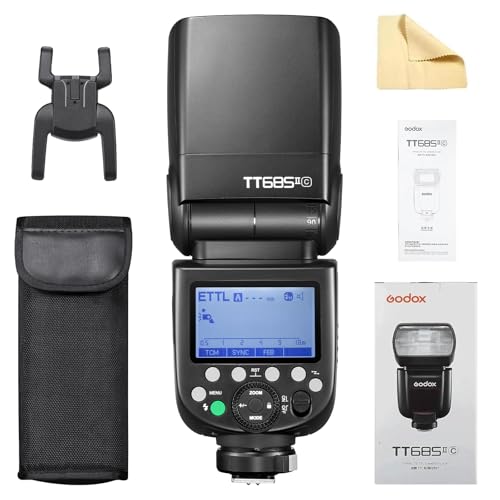
GN60 HSS Speedlite – Godox TT685II-C for Canon
If you need camera flashes with high speed sync for Canon and want more output than a compact mini flash, the Godox TT685II-C is a strong option. It offers GN60 power, TTL, HSS up to 1/8000s, and a built-in 2.4G wireless X system for flexible flash control.
Best For: Canon photographers who want a fuller-featured speedlite with strong output and wireless support.
Pros:
- GN60 output gives more headroom for bouncing and larger scenes
- High-speed sync up to 1/8000s supports wide-aperture daylight shooting
- Built-in 2.4G wireless X system offers up to 100 meters of transmission
- Updated quick lever lock, USB-C, and external power port add convenience
Cons:
- Not water resistant
- Uses optical pulse wireless tech rather than a dedicated radio trigger package in the box
The TT685II-C is the most traditional full-size speedlite in this group, with the output and control options many Canon shooters expect. It’s a solid pick when you want stronger light, flexible head movement, and HSS without stepping up to a more complex system.
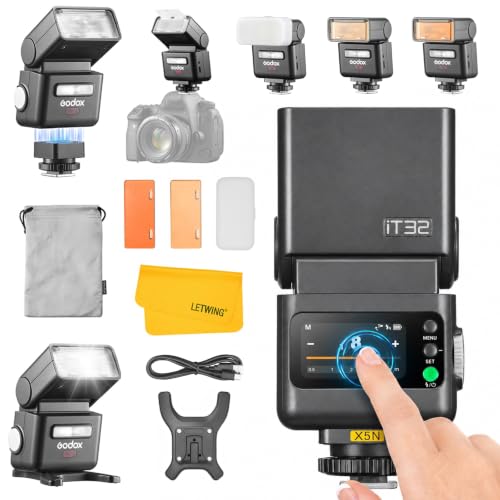
Smart Nikon Hybrid – Compact TTL/HSS Flash
If you want camera flashes with high speed sync that also make setup simpler, the Godox iT32 is built for fast Nikon workflows. It combines TTL, HSS up to 1/8000s, a built-in 2.4G receiver, and a magnetic detachable design, so you can move from on-camera to off-camera use without slowing down.
Best For: Nikon shooters who want a compact flash for quick hybrid on-camera and wireless setups.
Pros:
- Supports TTL, manual power from 1/128 to 1/1, front/rear curtain sync, and HSS 1/8000s.
- Built-in 2.4G receiver and X5N trigger communication allow wireless multi-light control without manual pairing.
- Magnetic detachable hotshoe/trigger design speeds up switching between shooting modes.
- Includes LED modeling light, reflector, diffuser, touchscreen, and USB-C charging.
Cons:
- X5 module charging depends on attaching it to the iT32 body and using the flash’s USB-C port.
- Guide number 18 is modest compared with larger speedlites.
Overall, this is a practical pick if you value speed, wireless flexibility, and compact size over maximum output. It looks especially useful for photographers who switch between simple on-camera work and more advanced multi-flash setups.
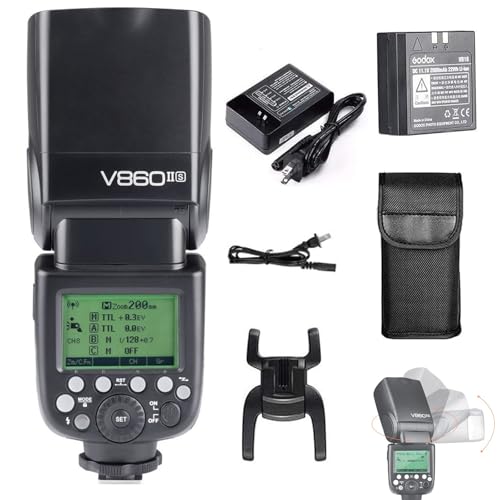
Power Sony Workhorse – Li-ion HSS Speedlite
Among camera flashes with high speed sync, the Godox V860II-S stands out as a straightforward Sony speedlite with strong battery support and proven wireless features. It offers TTL, 1/8000s HSS, a built-in 2.4G wireless system, and a rechargeable lithium battery designed for fast recycle times and long shooting sessions.
Best For: Sony users who want a dependable battery-powered flash for TTL and high-speed sync work.
Pros:
- Supports TTL, manual, multi modes, second curtain sync, and 1/8000s high-speed sync.
- Built-in 2.4G wireless X system supports master and slave flash operation.
- Li-ion battery delivers up to 650 full-power pops and a 1.5s recycle time.
- GN60 output and overheating protection add practical shooting headroom.
Cons:
- Uses the older V860II platform rather than a newer UI or interface design.
- Details list wired connectivity, so the core value is clearly in the flash unit itself rather than a modern trigger ecosystem.
This is a solid pick if you want a battery-powered Sony flash that prioritizes performance basics over extra bells and whistles. The combination of fast recycle, HSS, and wireless control makes it easy to use for both casual and more demanding sessions.
Feature-Rich Canon Pick – 76Ws TTL HSS Flash
If you are comparing camera flashes with high speed sync for Canon, the NEEWER Z880-C brings a lot of practical features into one unit. It combines 76Ws output, 1/8000s HSS, TTL and manual control, an upgraded UI, and a built-in 2.4G wireless system that can integrate with compatible Godox 2.4G X system gear.
Best For: Canon users who want a powerful feature-heavy flash with flexible wireless control.
Pros:
- 76Ws output, GN60, and 1/8000s HSS give it strong versatility for everyday flash work.
- New UI, HD LCD, and TCM switch make TTL-to-manual transitions easier to manage.
- Built-in LED modeling lamp, flexible head movement, and stroboscopic mode add creative options.
- Built-in 2.4G wireless support works with master/slave grouping and QPRO-C trigger compatibility.
Cons:
- Compatibility list excludes some Canon bodies, including RP and R50.
- It relies on a separate QPRO-C trigger for the full wireless control experience.
For Canon shooters who want a feature-dense flash, this is the most all-around option in the group. It balances power, HSS, wireless control, and a modern interface in a single package.
How We Picked the Best Camera Flashes with High Speed Sync
We focused on Camera Flashes with High Speed Sync that offer real value for everyday shooters, not just spec-sheet appeal. Priority went to models with dependable 1/8000s HSS support, useful TTL automation, solid power output, and strong compatibility within Canon, Sony, Nikon, and multi-brand ecosystems.
We also looked at practical details that affect usability in the field: round-head versus traditional head design, lithium-ion versus AA power, recycle speed, wireless control, and whether the flash is easy to adjust on the camera or off it.
Quick Comparison
For the fastest all-around setup, battery-powered TTL flashes usually make sense for events and portraits because they recycle quickly and stay consistent during long shoots. If budget matters more, AA-powered flashes can still deliver strong HSS performance at a lower cost. Round-head models often provide a smoother light spread, while classic rectangular heads may feel more familiar and easier to modify.
Key Buying Factors for Camera Flashes with High Speed Sync
HSS Range and Triggering
Not every flash handles HSS the same way once you move off-camera. Check that the flash supports your camera system and works with the trigger or wireless protocol you plan to use. Reliable HSS matters most when you need to reduce ambient light outdoors or shoot portraits at a shallow depth of field.
TTL, Manual Control, and Recycle Time
TTL helps speed up exposure setup, but manual power control is still important for repeatable results. Faster recycle times are especially valuable for events, candid work, and burst shooting, where missed moments can cost you the shot.
Power Source and Output
Lithium-ion flashes tend to deliver more consistent performance over long sessions and usually recharge faster between bursts. AA-based options can be more affordable and flexible, but may need extra spare batteries. Power output, often shown in Ws or GN ratings, affects how much room you have when using HSS in bright conditions.
Head Design and Modifiers
Round-head flashes can produce softer, more even light, while standard heads often pair well with common modifiers and accessories. If you use diffusers, gels, or bounce techniques often, make sure the design fits your style.
Who Should Buy Which Camera Flashes with High Speed Sync?
Choose a lithium-ion TTL flash if you shoot weddings, events, or portrait sessions and want speed plus consistency. Pick a budget AA flash if you need a capable backup or an entry point into HSS without spending much. Go with a round-head model if you care about smoother light quality and a more polished on-camera look. If you use wireless flash a lot, prioritize the model that matches your camera brand and trigger system most closely.
In short, the best Camera Flashes with High Speed Sync are the ones that match your shooting pace, your camera system, and the way you actually work.