Choosing the right monitor can make framing, focus, and exposure far easier on set. The best field monitors give you a brighter, more accurate view than a camera LCD, especially outdoors.
In this roundup, we focus on practical buying factors like screen size, brightness, touchscreen controls, and monitoring tools so you can match the right display to your workflow.
Best 10 Field Monitors Picks for 2026
Bright 7-inch all-rounder
NEEWER F700 7" 2000nit Touch Monitor

- 2000-nit 7-inch IPS touchscreen
- Waveform, vectorscope, LUT upload, and HDR tools
- HDMI loop in/out plus NP-F, DC, and Type-C power
Best For: Daylight shooting with full-feature monitoring
Compact daylight choice
VILTROX 5.5" 1200-Nit 4K HDMI Monitor

- 1200-nit 5.5-inch 1080p touchscreen
- Focus, exposure, audio, and anamorphic tools
- Custom LUTs via SD card and LOG to Rec.709 support
Best For: Portable rigs and lighter camera setups
Ultra-bright touch monitor
FEELWORLD F5 Prox 5.5" 1600nit

- 1600-nit brightness for outdoor viewing
- Focus peaking, waveform, histogram, false color, and LUT preview
- Compact, rig-friendly 5.5-inch touchscreen
Best For: Outdoor shooters wanting a compact bright monitor
Camera-control pick
VILTROX DC-550 Pro II 5.5" 1400 Nits

- 1400-nit 5.5-inch full HD touchscreen
- USB-C and Wi-Fi camera control for supported models
- Rec.709 tools, LUT import, and 4K@60 I/O
Best For: Creators who want monitor and camera control in one
Portable Bundle Pick
FEELWORLD S55 V3 6-inch 4K field monitor bundle
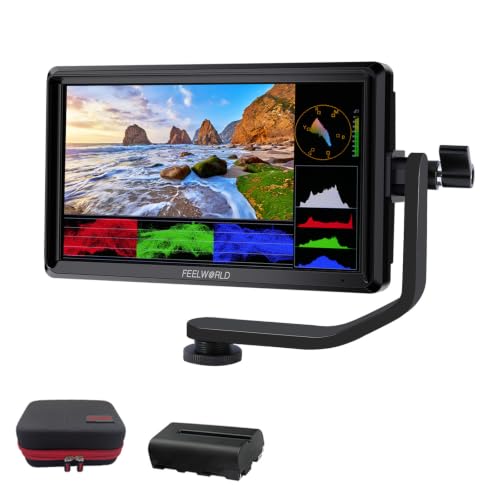
- 6-inch 1080p screen with 160° viewing angle
- 4K HDMI input plus loop-out for monitoring chains
- Bundle includes battery, case, sunshade, and tilt arm
Best For: Shooter-friendly starter kit for handheld and gimbal setups
Budget 7-Inch Option
NEEWER F100 7-inch HD IPS field monitor

- 7-inch IPS display with 1280x800 resolution
- 450-nit brightness with sunshade included
- Peaking, check field, safe frames, and image flip tools
Best For: Entry-level monitoring on a tighter budget
Advanced Compact Pick
Portkeys PT6 5.2-inch touchscreen field monitor

- 5.2-inch Full HD touchscreen with 600-nit brightness
- 3D LUT output, waveform, false color, and zebra tools
- Slim 0.37 lb design with wide 178° viewing angle
Best For: Compact rig setups that need advanced exposure and color tools
High-Bright All-Rounder
VILTROX DC-550 5.5" Touchscreen Field Monitor

- 1200-nit display for daylight viewing
- Waveform, vector, histogram, and false color tools
- Includes NP-F550 battery and HDMI in/out
Best For: shooters who need a bright, feature-rich monitor for outdoor work
Budget-Smart Outdoor Pick
Desview P5II 5.5" HDMI Field Monitor

- 800-nit screen for better sunlight visibility
- Waveform, vectorscope, false color, and focus peaking
- Corner bumpers plus included sunshade
Best For: users who want a practical monitor with good outdoor visibility and protection
Workflow-Focused Choice
osee T5+ 5.5" Bright Field Monitor

- 1000-nit screen for outdoor use
- 8 MySets and custom false color presets
- LOG/HDR preview with user LUT support
Best For: crews and solo shooters who want fast, repeatable on-set monitoring
Bright 7-inch all-rounder – NEEWER F700 7" 2000nit Touch Monitor
If you want a field monitor that stays easy to read in harsh light, the NEEWER F700 is built for practical on-set checking. Its 7-inch 1080p touchscreen, 2000-nit brightness, and wide viewing angle make it a strong fit for outdoor work, while the built-in exposure and focus tools help you verify framing, color, and sharpness fast.
Best For: Creators who need a bright 7-inch field monitor with lots of pro monitoring tools and flexible power options.
Pros:
- 2000-nit 7-inch IPS touchscreen is designed for daylight visibility.
- Includes waveform, vectorscope, histogram, false color, zebras, HDR, and more.
- Supports HDMI loop in/out up to 4K plus headphone audio monitoring.
- Multiple power options: NP-F batteries, DC, and Type-C charging.
Cons:
- Larger 7-inch build and included batteries make it heavier than compact monitors.
- DC cable is not included.
- Best performance depends on having the right batteries or fast USB-C power.
Overall, the F700 is a feature-rich option if you want one of the more versatile field monitors for bright-location shooting. It combines strong visibility, extensive assist tools, and flexible mounting and power support in a single package.
Compact daylight choice – VILTROX 5.5" 1200-Nit 4K HDMI Monitor
The VILTROX DC-550 is a practical pick if you want a compact field monitor with solid daylight visibility and a lightweight rig-friendly design. Its 5.5-inch 1080p screen, 1200-nit output, and built-in focus and exposure tools make it useful for everyday camera monitoring without adding much bulk.
Best For: Shooters who want a smaller field monitor with strong brightness, LUT support, and simple rig mounting.
Pros:
- 1200-nit brightness helps the screen stay readable outdoors.
- Includes focus, framing, exposure, and audio tools plus anamorphic de-squeeze.
- Supports custom 3D LUTs via SD card and built-in LOG to Rec.709 viewing.
- Compact layout includes touchscreen control, shortcut key, and sunshade.
Cons:
- 5.5-inch screen is smaller than many full-size field monitors.
- Only one HDMI port is listed.
- Brightness is lower than the brightest outdoor-focused models in this roundup.
For creators who value portability, the DC-550 keeps the essentials in a smaller package. It is a balanced field monitor for those who want reliable visibility and useful assist tools without moving up to a larger 7-inch unit.
Ultra-bright touch monitor – FEELWORLD F5 Prox 5.5" 1600nit
The FEELWORLD F5 Prox is aimed at creators who need a bright, easy-to-read field monitor for outdoor shooting and accurate on-camera checks. With a 5.5-inch touchscreen and 1600-nit brightness, it is designed to make focus, exposure, and framing easier to judge in bright conditions.
Best For: Videographers, vloggers, and filmmakers who want a compact high-brightness field monitor with core exposure tools.
Pros:
- 1600-nit display is built for outdoor visibility.
- Includes focus peaking, waveform, histogram, false color, and LUT preview.
- Compact 5.5-inch size works well on rigs, cages, gimbals, and handheld setups.
- Designed for DSLR, mirrorless, and cinema cameras with standard mounting points.
Cons:
- Smaller screen size may feel limited for users who prefer larger monitors.
- Notes do not list advanced connectivity features beyond the monitor’s core use.
- Battery details are minimal in the supplied information.
This is a straightforward field monitor choice for creators who want brightness and essential pro tools in a compact form. It focuses on the fundamentals and should appeal to shooters who need a light monitor that is easier to mount and easier to see outdoors.
Camera-control pick – VILTROX DC-550 Pro II 5.5" 1400 Nits
The VILTROX DC-550 Pro II is a feature-heavy field monitor built for creators who want camera control along with a bright touchscreen. Its 5.5-inch 1080p panel, 1400-nit brightness, and support for USB-C wired or Wi-Fi camera control make it especially useful when you want to adjust camera settings without digging through body menus.
Best For: Shooters who want a bright field monitor with built-in camera control and advanced monitoring tools.
Pros:
- 1400-nit touchscreen is designed for use in strong outdoor light.
- USB-C wired and Wi-Fi direct camera control support many shooting adjustments.
- Includes Rec.709 color management, 3D LUT import, waveform, vectorscope, histogram, and onion skin.
- Supports 4K@60 signal input and output with multiple power options.
Cons:
- Camera control compatibility is limited to the listed supported models.
- 5.5-inch screen may be small for users who prefer larger field monitors.
- Advanced features may be more than casual users need.
For users who want more than basic monitoring, the DC-550 Pro II stands out as a practical control hub. It combines useful camera adjustment features with the tools and brightness expected from capable field monitors, making it a strong choice for solo shooters and small crews.
Portable Bundle Pick – FEELWORLD S55 V3 6-inch 4K field monitor bundle
If you want a lightweight field monitor for run-and-gun shooting, the FEELWORLD S55 V3 is built to stay out of the way while still giving you a clear, practical image on set. This 6-inch monitor pairs Full HD resolution with 4K HDMI input and loop-out, plus onboard exposure and focus tools that help make fast framing and checking easier.
Best For: Handheld rigs, gimbals, and DSLR or mirrorless shooters who want an all-in-one monitor bundle.
Pros:
- 6-inch 1920×1080 display with 160° viewing angle and 500 cd/m² brightness
- 4K HDMI input with HDMI loop-out for sending the signal to another display
- Includes NP-F battery, carry case, sunshade, tilt arm, and cables
- Monitoring tools include histogram, peaking, false color, zebra, zoom, and image flip
Cons:
- Smaller 6-inch screen may feel tight for users who prefer larger field monitors
- Only one battery is included in the bundle
- Dummy battery/coupler for powering the camera is not included
Overall, this is a straightforward pick for shooters who want a portable field monitor with useful pro tools and a complete starter kit. The included accessories make it especially appealing if you need something ready to mount and use quickly.
Budget 7-Inch Option – NEEWER F100 7-inch HD IPS field monitor
The NEEWER F100 is a practical field monitor for creators who want a larger 7-inch display without adding much bulk. Its IPS panel, 1280×800 resolution, and 450-nit brightness make it a functional choice for checking focus and composition, while the included sunshade helps outdoors.
Best For: Budget-conscious videographers using DSLR cameras, camcorders, or stabilizers.
Pros:
- 7-inch IPS panel with 1280×800 resolution and 16:10 aspect ratio
- 450 nits of brightness with included sunshade for outdoor viewing
- Useful monitoring tools such as peaking, check field, safe frames, pixel-to-pixel, and image flip
- Wide device compatibility with DSLR cameras, camcorders, cranes, and stabilizers
Cons:
- Resolution is lower than Full HD monitors
- Brightness is adequate, but not especially strong for very bright daylight
- Viewing angle is listed at 80 degrees, which is narrower than some rivals
For buyers comparing field monitors on value, the F100 stands out as a simple, functional screen with a useful feature set. It is best suited to users who care more about getting a larger monitoring image than having the most advanced display specs.
Advanced Compact Pick – Portkeys PT6 5.2-inch touchscreen field monitor
The Portkeys PT6 is a compact field monitor aimed at shooters who want advanced image tools in a small, lightweight body. With a 5.2-inch Full HD touchscreen, 600-nit brightness, and wide 178° viewing angle, it gives you a sharp monitoring solution for more precise exposure, color, and framing checks.
Best For: Shooters who want a compact touchscreen monitor with waveform and LUT support.
Pros:
- 5.2-inch 1920×1080 touchscreen with 600 nits brightness
- Advanced tools including 3D LUT output, waveform, histogram, false color, and zebra
- Wide 178° viewing angle and slim 0.37 lb design
- Supports NP-F and LP-E6 battery options for flexible powering
Cons:
- Smaller screen size may be limiting for users who want more display area
- Battery is not included
- Uses a glossy screen finish, which may not suit every lighting situation
The PT6 makes sense if your priority is feature depth rather than screen size. Its touchscreen interface and waveform tools give it a more advanced feel than basic field monitors, especially for users who rely on LUTs and exposure aids.
High-Bright All-Rounder – VILTROX DC-550 5.5" Touchscreen Field Monitor
If you need field monitors that stay readable outdoors while still giving you pro-level exposure tools, the VILTROX DC-550 is built for that job. Its 1200-nit screen, 5.5-inch IPS panel, and 4K HDMI in/out make it a practical on-camera display for DSLR, mirrorless, cinema, and video setups.
Best For: Filmmakers and shooters who want a bright, feature-packed monitor for daylight use and flexible monitoring.
Pros:
- 1200-nit brightness helps with daylight viewing.
- Includes waveform, vector, histogram, false color, focus assist, and other monitoring tools.
- Supports custom 3D LUTs via SD card for log monitoring and creative looks.
- HDMI in/out supports up to 4K 30Hz and can pass signal to another display or recorder.
Cons:
- 5.5-inch screen size may feel compact for users wanting a larger monitor.
- Battery is limited to the included NP-F550 unit, so longer shoots may need extra power planning.
Overall, the DC-550 is a strong value if you want a bright, versatile field monitor with a full set of on-set tools and flexible power options. It covers the essentials well for run-and-gun shooting, small crews, and DSLR rigs.
Budget-Smart Outdoor Pick – Desview P5II 5.5" HDMI Field Monitor
Among field monitors in this size class, the Desview P5II stands out for solid outdoor visibility and a useful set of monitoring features. Its 800-nit display, 5.5-inch IPS panel, and 4K HDMI input/output make it a straightforward option for DSLR shooters who want a practical on-camera monitor without extra complexity.
Best For: Shooters who want a dependable field monitor with good sun visibility and straightforward monitoring tools.
Pros:
- 800-nit brightness improves visibility in bright sunlight.
- Includes waveform, vectorscope, histogram, false color, focus peaking, and zoom.
- HDMI in/out supports 4K passthrough to another display or recorder.
- Rubber corner bumpers and a velcro sunshade add protection and usability on set.
Cons:
- Brightness is lower than some higher-end competitors in this roundup.
- NP-F battery is not included, so you’ll need to supply your own power source.
The P5II is a sensible pick if you want a well-rounded monitor with basic durability extras and the essential tools needed for exposure and focus checks. It keeps the feature set useful without pushing into overly complicated territory.
Workflow-Focused Choice – osee T5+ 5.5" Bright Field Monitor
If your priority is speed on set, the osee T5+ is one of the more workflow-oriented field monitors in this group. It combines 1000-nit brightness with customizable false color tools, 8 MySets presets, and built-in LOG/HDR preview features, making it especially useful for shooters who change setups often.
Best For: Crews and solo shooters who want fast access to customized monitoring presets and exposure tools.
Pros:
- 1000-nit display is well suited to outdoor filming.
- Custom false color tools and camera-model presets can be tailored for faster exposure checks.
- 8 MySets let you save and switch between monitoring setups quickly.
- Supports LOG/HDR live preview and user LUT uploads via SD card.
Cons:
- Battery is not included, so power needs to be planned separately.
- Color and workflow features are a bigger selling point than raw screen size or extra accessories.
The T5+ makes the most sense if you value efficiency and repeatable setups more than bundled extras. Its preset-driven interface and strong monitoring tools can save time on location, especially when moving between cameras or shooting styles.
How We Picked the Best Field Monitors
We looked for Field Monitors that balance visibility, image tools, build quality, and everyday usability. Priority went to models with strong brightness for outdoor shooting, dependable HDMI compatibility, useful assist tools, and features that make real production work easier, such as touch control, camera control support, and LUT monitoring.
Quick Comparison: What Matters Most
For run-and-gun shooting, a compact 5 to 5.5-inch monitor is usually easier to rig and power. For more comfort on a tripod or shoulder setup, a 7-inch display can be easier to judge focus and composition. Higher brightness helps most when shooting in daylight, while 4K input support, false color, waveform, and vectorscope are most useful for creators who want stronger exposure control.
Key Buying Factors for Field Monitors
Brightness and Outdoor Visibility
If you shoot outdoors often, prioritize a brighter panel. A monitor with 1200 nits or more is generally more usable in sunlight, while lower-brightness models can still work well indoors or with a hood.
Screen Size and Resolution
Smaller monitors are lighter and easier to mount, but larger screens can improve focus checking and shot framing. Native resolution also matters, especially when you want a sharper image for critical work.
Monitoring Tools and Camera Control
Helpful tools like 3D LUT support, waveform, vectorscope, false color, and peaking can speed up exposure and color decisions. Some Field Monitors also offer camera control, which can simplify operation when you need fast access to settings.
Power and Rig Compatibility
Check battery options, mounting points, and included accessories before you buy. A monitor that fits your power setup and cage or arm system will be easier to use consistently.
Who Should Buy Which Field Monitors?
Traveling creators and gimbal users should lean toward smaller, lighter models. Indie filmmakers and content teams who need a bigger viewing area may prefer a 7-inch display with strong brightness. If you shoot in changing light, choose one of the brighter Field Monitors with LUT and exposure tools. If your goal is simple framing and basic focus assistance, a more affordable 4K HDMI monitor can be the most practical choice.
For most buyers, the best option is the one that matches your shooting environment first, then adds the features you will actually use every day.