Choosing among the best multitrack podcast recorders can make remote interviews, group discussions, and on-location production much easier. The right model gives each microphone its own track, simplifies monitoring, and helps you capture cleaner audio.
This roundup includes compact podcast-focused recorders, expandable field recorders, and multitrack units designed for musicians who also want podcasting flexibility. Compare inputs, headphone support, portability, and workflow before you buy.
Best 10 Multitrack Podcast Recorders Picks for 2026
Best All-in-One Podcast Hub

- Four XLR inputs and four headphone outputs
- Separate tracks for voices and Sound Pads
- Mix-minus for phone and remote interviews
Best For: Multi-person podcasts and remote interviews
Best for Touchscreen Multitrack Production

- Eight-track recording with touchscreen editing
- Built-in drum loops, synths, effects, and MIDI
- Runs up to five hours on four AA batteries
Best For: Podcasts with music and hands-on production
Best Versatile Field Recorder

- Four XLR/TRS inputs with gain, pads, and phantom power
- Includes XY and MS stereo microphone capsules
- Supports multichannel USB audio and SD recording
Best For: Portable podcast, video, and field recording
Best for Clip-Free Portable Recording

- Four-track recording with stereo mics and two XLR/TRS inputs
- 32-bit float capture helps prevent clipped takes
- USB-C recording with simultaneous SD backup
Best For: Portable podcasts, video audio, and interviews
Best Value Podcast Kit

- Independent headphone mixes
- Phone and computer call-ins
- Includes mic, headphones, stand, card, and power accessories
Best For: New and mobile podcasters building a complete interview setup
Best for Music Layering

- Four-track recording and bouncing
- 32-bit float capture
- Built-in rhythms and USB audio interface
Best For: Musicians and hybrid creators recording podcasts, instruments, and demos
Best Premium Podcast Bundle

- Four XLR inputs with phantom power
- Four independent headphone outputs
- Includes two complete microphone packs
Best For: Panel podcasts and professional multi-person recordings
Best Computer-Free Multitrack Recorder
- Up to 16 tracks and eight simultaneous tracks
- Touchscreen recording, editing, and mixing
- Six XLR inputs plus onboard rhythms and effects
Best For: Musicians and creators recording complete projects without a computer
Best Portable Podcast Starter Bundle

- Four XLR inputs and four headphone outputs
- Separate WAV tracks with Mix-Minus call support
- Includes mic, headphones, card, pop filter, and batteries
Best For: Small podcast teams needing a ready-to-record kit
Best Four-Mic Podcast Package

- Four mic inputs and four headphone outputs
- Includes four microphone packs and pop-filter sets
- Rechargeable batteries, charger, and 64GB card included
Best For: Four-person podcast teams building a complete recording station
Best All-in-One Podcast Hub – PodTrak P4
The Zoom PodTrak P4 is one of the most purpose-built multitrack podcast recorders here, with four XLR microphone inputs, separate headphone outputs, and tools for remote interviews. Its battery-powered design also suits mobile podcast setups.
Best For: Multi-person podcasts, call-in interviews, and creators who need individual headphone monitoring.
Pros:
- Four XLR inputs with phantom power support multiple microphones.
- Four headphone outputs include individual volume control.
- Records inputs and Sound Pads as separate tracks.
- Automatic mix-minus supports phone and remote interviews.
Cons:
- Battery life is rated at up to 3.5 hours on two AA batteries.
- Its feature set is focused on podcast production rather than broader music recording.
Choose the P4 when straightforward guest management and multitrack podcast workflow matter more than extensive musical production features. The dedicated inputs, headphone monitoring, and remote-interview support make it especially practical for podcast teams.
Best for Touchscreen Multitrack Production – Zoom R12
The Zoom R12 is a portable multitrack recorder designed more like a compact recording studio. It offers eight tracks, touchscreen editing, onboard effects, and built-in rhythm and synth tools, making it a strong option for podcasts that may also include music or produced segments.
Best For: Creators who want hands-on editing, music beds, drum loops, and an eight-track portable workflow.
Pros:
- Records up to eight tracks with two XLR/TRS inputs.
- Color touchscreen supports cutting, copying, looping, and mixing without a computer.
- Includes 150 drum loops, 18 FM synth instruments, and MIDI support.
- Works as a stereo USB-C audio interface and DAW control surface.
Cons:
- Only two XLR/TRS inputs are provided for microphones or instruments.
- USB-C operation is described as a stereo interface rather than an eight-channel interface.
The R12 is a compelling choice if your multitrack podcast recorder also needs to handle music production and touchscreen editing. Its limited input count may matter for larger panel shows, but its eight-track layout and onboard creative tools add considerable flexibility.
Best Versatile Field Recorder – Zoom H6
The Zoom H6 combines built-in stereo microphones with four XLR/TRS inputs, giving it the flexibility needed for multitrack podcasting, video production, music, and field recording. It records directly to SD cards and can also operate as a USB audio interface.
Best For: Podcasters and filmmakers who need portable recording with interchangeable recording approaches and multiple external inputs.
Pros:
- Four XLR/TRS inputs include individual gain controls, pads, and phantom power.
- Includes XY and MS microphone capsules for stereo recording options.
- Supports multichannel and stereo USB audio interface modes.
- Records WAV or MP3 audio at up to 24-bit/96kHz.
Cons:
- Its four external inputs may be less convenient than the P4 for a four-person podcast with separate headphone outputs.
- Some mounting accessories are optional, including the HS-01 hot shoe adapter.
The H6 remains a flexible pick when your multitrack podcast recorder needs to travel between studio, field, video, and music assignments. Its included microphone capsules and four external inputs let you adapt the setup to different recording situations.
Best for Clip-Free Portable Recording – Zoom H4 Essential
The Zoom H4 Essential is a compact multitrack podcast recorder for creators who want built-in stereo microphones, two XLR/TRS inputs, and 32-bit float recording. It can save audio to an SD card while connecting to a phone, tablet, or computer over USB-C.
Best For: Podcasters, filmmakers, and musicians who want portable recording with a backup copy and clip-free capture.
Pros:
- Four-track recording combines built-in stereo microphones with two XLR/TRS inputs.
- 32-bit float recording is designed for clip-free audio capture.
- Can record or stream through USB-C while saving a backup to an SD card.
- Spoken menu guidance can make operation more accessible.
Cons:
- It has two external XLR/TRS inputs, fewer than the PodTrak P4 and H6.
- Two AA batteries provide a portable power option, but the supplied notes do not specify battery life.
The H4 Essential is a practical choice when portable versatility and recording safety are priorities. Its four-track design is suitable for compact setups, while 32-bit float capture and simultaneous device-and-SD recording add reassurance for unpredictable audio levels.
Best Value Podcast Kit – PodTrak P4 Bundle
For creators comparing multitrack podcast recorders, this PodTrak P4 bundle stands out as a ready-to-use setup for interviews and group shows. It includes the recorder, microphone, headphones, stand, cable, memory card, batteries, charger, and windscreen.
Best For: New and traveling podcasters who want a complete recording kit with independent headphone monitoring.
Pros:
- Four independent headphone mixes with individual level controls.
- Supports phone and computer call-ins, including two remote guests at once.
- Includes essential recording accessories and a 32GB SDHC memory card.
Cons:
- The BTA-2 Bluetooth receiver for wireless call-ins is sold separately.
- The bundle is relatively heavy at 2.38 kg.
This is a practical all-in-one choice for interviewers and panel hosts who need flexible monitoring and remote-call options without assembling every accessory separately.
Best for Music Layering – Zoom R4 Multitrack Recorder
The Zoom R4 is a flexible option among multitrack podcast recorders for users who also record music, instruments, or creative demos. Its four-track workflow supports recording, layering, bouncing, and repeating, while 32-bit float recording helps reduce clipping concerns.
Best For: Musicians and podcasters who want a compact recorder with rhythm patterns, effects, and USB audio-interface functionality.
Pros:
- Records up to four tracks and can bounce them to a dedicated track.
- Two XLR/TS combo inputs accommodate microphones, instruments, and keyboards.
- Includes over 80 built-in rhythm patterns and works as a 2-in/2-out USB interface.
Cons:
- Its feature set is more music-oriented than podcast-specific.
- Runs on four AA batteries or USB-C, so battery life depends on the chosen power source.
Choose the R4 if layering and musical flexibility matter as much as spoken-word recording. It is especially appealing for creators who want one portable device for recording ideas and connecting to a computer or smartphone.
Best Premium Podcast Bundle – PodTrak P4next Kit
This P4next bundle is designed for polished group podcasting, combining the recorder with two microphone packs, headphones, windscreens, cables, and desktop stands. Its AI noise reduction, voice compression, four XLR inputs, and individual headphone controls target professional multi-person productions.
Best For: Interviewers and panel hosts who need four-microphone support, flexible monitoring, and bundled recording accessories.
Pros:
- Four XLR inputs provide up to +70 dB of gain and 48 V phantom power.
- Four headphone outputs offer individual volume control for guests and hosts.
- AI noise reduction, tone shaping, and voice compression support clearer speech.
- Includes two complete ZDM-1 microphone packs with stands and accessories.
Cons:
- Its listed bundle weight is 6 pounds, making it less convenient for lightweight travel.
- Battery operation uses two AA batteries and is rated for approximately 3.5 hours.
The P4next is the strongest fit here for larger, more polished productions. Its four-input design and personalized monitoring make it well suited to panels, while the included microphone packs reduce setup work.
Best Computer-Free Multitrack Recorder – Zoom R20
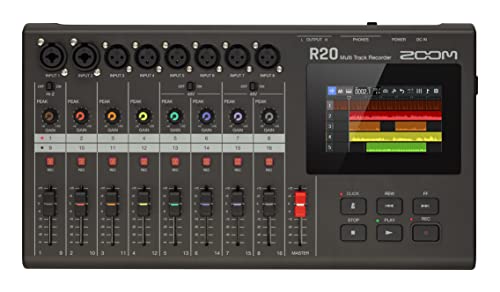
The Zoom R20 is a practical choice for musicians who want multitrack podcast recorders or project-recording equipment that can work without a computer. Its touchscreen workflow supports recording, editing, and mixing directly on the device, with up to 16 tracks and up to eight simultaneous tracks.
Best For: Musicians, demo production, and creators who want hands-on multitrack recording without external software.
Pros:
- Records up to 16 tracks, with up to eight captured simultaneously.
- Six XLR inputs, including two XLR/TRS combo inputs, support multiple sources.
- Touchscreen editing, onboard effects, 150 rhythm patterns, and 18 synth sounds add flexibility.
Cons:
- Its maximum sample rate is 44.1 kHz.
- The 4.3-pound tabletop design is less focused on ultra-portable recording.
The R20 stands out when direct, computer-free control matters more than a compact field setup. It also doubles as a USB interface for Windows and macOS systems.
Best Portable Podcast Starter Bundle – Zoom PodTrak P4 Kit
This Zoom PodTrak P4 bundle is a convenient entry point for multitrack podcast recorders, combining the portable recorder with a microphone, headphones, memory card, pop filter, stand, cable, and batteries. It supports four XLR microphones, separate headphone monitoring, and individual tracks for each input.
Best For: Small podcast teams that want a ready-to-use four-person recording setup with included accessories.
Pros:
- Four XLR inputs and four individually controlled headphone outputs support group recording.
- Records each input separately in 16-bit/44.1 kHz WAV format.
- Mix-Minus, TRRS phone connectivity, sound pads, SD recording, and USB interface mode expand its uses.
- The bundle includes a handheld microphone, headphones, 64GB microSD card, pop filter, stand, cable, and batteries.
Cons:
- Battery life is listed at about three hours.
- The recorder uses a 2-inch screen and a 2-input/2-output USB interface.
For new podcasters, the included accessories reduce setup friction while the P4’s isolated tracks and monitoring controls leave room for more flexible editing later.
Best Four-Mic Podcast Package – Zoom PodTrak P4 Bundle
This expanded PodTrak P4 package is designed for podcast crews looking at multitrack podcast recorders with a complete four-person accessory setup. The recorder provides four XLR inputs, four headphone outputs, separate-track WAV recording, phone call support, and sound pads, while the bundle adds four microphone packs and rechargeable power accessories.
Best For: Four-person podcast sessions that need microphones, headphones, pop filters, stands, storage, and rechargeable batteries in one package.
Pros:
- Four XLR inputs and four individually adjustable headphone outputs suit group recording.
- Each source can be recorded on a separate 16-bit/44.1 kHz WAV track.
- The package includes four DM1-PMP microphone packs with headphones, XLR cables, windscreens, and tabletop stands.
- Rechargeable batteries and a charger, a 64GB card, four pop-filter boom-arm sets, and headphone hangers are included.
Cons:
- Its listed weight is 11.79 kg, making this bundle less convenient to transport.
- Battery operation is listed at up to three hours.
- The P4’s USB mode is limited to two inputs and two outputs.
This is the more complete choice for a fixed or semi-permanent four-person studio. It costs less setup time than assembling microphones, monitoring, and accessories separately, while retaining the P4’s portable recording features.
How We Picked These Multitrack Podcast Recorders
We focused on recording flexibility, input capacity, monitoring options, portability, and practical workflow. Podcast-specific features such as multiple headphone outputs, phone connectivity, sound pads, and easy track management received particular attention. We also included versatile field and music recorders because they can be useful for creators who record live events, instruments, voiceovers, or podcasts.
Bundle contents were considered separately from the recorder itself. A package with microphones, headphones, cables, storage, or a stand may offer better starting value, but buyers should still verify the quality and compatibility of the included accessories.
Quick Comparison
- Best for panel podcasts: Zoom PodTrak P4 models, with four microphone inputs and four headphone outputs.
- Best for music and podcast crossover: Zoom R12, R20, and R4 recorders, which emphasize tracks, effects, and musical production.
- Best for field recording: Zoom H6 and H4 Essential, which combine portable designs with microphones and external inputs.
- Best value from a complete kit: Bundles that add microphones, headphones, memory cards, cables, or stands.
Key Buying Factors for Multitrack Podcast Recorders
Inputs and Separate Tracks
Count how many people or sound sources you need to record at once. Four XLR inputs are suitable for many group podcasts, while two-input models work better for solo creators, two-person interviews, or music overdubs. Separate tracks let you adjust each voice independently during editing.
Headphone Outputs and Monitoring
For a roundtable show, each participant should be able to monitor comfortably. Four headphone outputs can eliminate the need for a separate headphone amplifier. Also check whether the recorder provides independent level control and low-latency monitoring.
Connectivity and Remote Interviews
Phone and USB connectivity can simplify guest calls, livestreams, and computer-based recording. Confirm how the device handles phone audio, mix-minus functionality, and computer compatibility if remote interviews are central to your workflow.
Portability, Storage, and Power
Battery operation and SD-card recording are valuable for travel and location work. Built-in microphones can provide a quick stereo capture, while XLR/TRS inputs offer more control with external microphones. Models with 32-bit float recording may provide additional protection against unexpected peaks, but proper microphone placement still matters.
Who Should Buy Which Multitrack Podcast Recorders?
Choose a PodTrak P4 if your priority is a straightforward podcast setup for multiple guests, separate headphone monitoring, and minimal equipment. Choose an H6 or H4 Essential if you need a recorder for podcasts plus general field recording, filmmaking, or live sound.
Choose an R12, R20, or R4 if music production, effects, drum patterns, or a larger track-based workflow matters as much as spoken-word recording. Finally, choose a bundle when you need to start immediately and the included accessories match your microphone style and recording environment. Before ordering, confirm the exact model, included accessories, storage capacity, and power requirements, since bundle contents can vary.